Pacific Spins

Chicken Road: How to Play, Test the Free Demo, and Choose a Safe Casino (Canada, 2026)

"In evaluating crash and decision-based games across Canadian operators, our objective is to peel back marketing claims and examine raw math, terms, and risk profiles. Chicken Road offers an unusually transparent look at player-driven volatility, but understanding the boundary between virtual practice and real-money exposure is critical before making a first CAD deposit." Reid Calloway, Independent Casino Analyst (editorial persona)

Last updated: January 2026 · Testing methodology: demo and real-money flows were re-verified on iOS 17/Safari and Android 14/Chrome, using an Interac e-Transfer deposit and a documented CAD withdrawal request (see the audit case study below). 19+ only. Gambling involves risk.


Provider

InOut Games

RTP

95.598.0%

Volatility

High

Min bet

$0.10

Max bet

$100

Max win

3,000,000x

Chicken Road How to Play, Test
Table of ContentCloseOpen
Quick Verdict for Canadian Players

Quick Verdict for Canadian Players

  • What it is:Chicken Road is a crash-style arcade game by InOut Games (released 2024). You set a stake in CAD, move a chicken tile by tile across a road, and cash out before hitting a trap. Payout = Stake × Current Multiplier.
  • Four difficulty modes, four risk profiles:Easy (24 stages, roughly 4% risk per step) through Hardcore (15 stages, roughly 40% risk per step). You choose the volatility. The house edge does not change.
  • RTP:95.5% to 98.0% depending on mode and operator configuration. High RTP does not mean a profitable session.
  • Free demo:runs in-browser with virtual credits, no registration required. Identical math, zero financial risk, and zero predictive value for real-money results.
  • Legality in Canada:Ontario players should use operators registered with iGaming Ontario / AGCO. Elsewhere in Canada, play runs through provincial lottery sites or internationally licensed (MGA/Kahnawake/UKGC) operators. Check your provincial rules first.
  • Payments:Interac e-Transfer is the fastest CAD rail (15 minutes to 2 hours). Complete KYC before your first real-money bet to avoid withdrawal delays.
  • Biggest trap:bonus wagering. Arcade and crash titles often contribute only 5% to 10% toward rollover. See the worked example below before accepting any bonus.
  • No winning system exists.Martingale and pattern-tracking cannot beat a certified RNG. Fixed unit sizing (0.25% to 3% of bankroll) is risk control, not a profit strategy.
Why This Guide Matters Before You

Why This Guide Matters Before You Deposit

Most Canadian search results for this title read like ads. They list the peak multiplier, praise the graphics, and quietly skip the two numbers that decide your outcome: per-step collision risk and bonus contribution rate.

Here is what that means for you. A 3,000,000x headline is irrelevant if the operator caps a single round at $10,000 CAD, and a "100% welcome bonus" can cost more to clear than it pays. Those are contract terms, not marketing details.

This guide keeps the focus on four checkable things: the actual game mechanics, the provincial legality of playing it, CAD payment speed, and the fine print that decides whether a win reaches your bank account. Nothing here promises profit. The goal is a full picture before your first deposit.

What Is Chicken Road Game and

What Is Chicken Road Game and How the Mechanics Work

Chicken Road is an arcade-style crash game developed by InOut Games in 2024, where players guide a character across multi-lane roads, accumulating higher payout multipliers with each safe step until cashing out or hitting a collision. Unlike traditional slot machines, where paylines and reel stops are completely passive, this road game places decision-making timing directly in the hands of the player.

The core game is built around a clear risk-reward trade-off. Every lane cleared raises the active multiplier, but an unannounced hazard can end the round in a sudden loss if the player fails to exit in time. A crucial structural difference from timer-based crash titles: the board does not advance on its own. The round only progresses when you decide to take the next step, and the length of the road is known before the round begins.

"Crash games advertise theoretically attractive multipliers, yet expected-value calculation shows the overall mathematical expectation remains negative." Scott et al., analysis of crash games (2023). https://pmc.ncbi.nlm.nih.gov/articles/PMC7044615/

(Updated citation. See Appendix A for the superseded reference.)

Core Terminology You Need Before Your

Core Terminology You Need Before Your First Round

  • Chicken:the player-controlled avatar that advances one tile at a time along a fixed-length path.
  • Traps:hidden hazardous tiles that cause an immediate collision and forfeit the round stake. Their density is set by the difficulty mode you choose.
  • Golden Egg:the final tile at the end of the road, awarding the maximum multiplier cap for that difficulty setting.
  • Bonus Steps:specific safe tiles that award incremental multiplier boosts along the path, accelerating payout growth beyond the base step increment.
  • Cash Out:the manual action that ends the round and credits Stake × Current Multiplier to your balance.
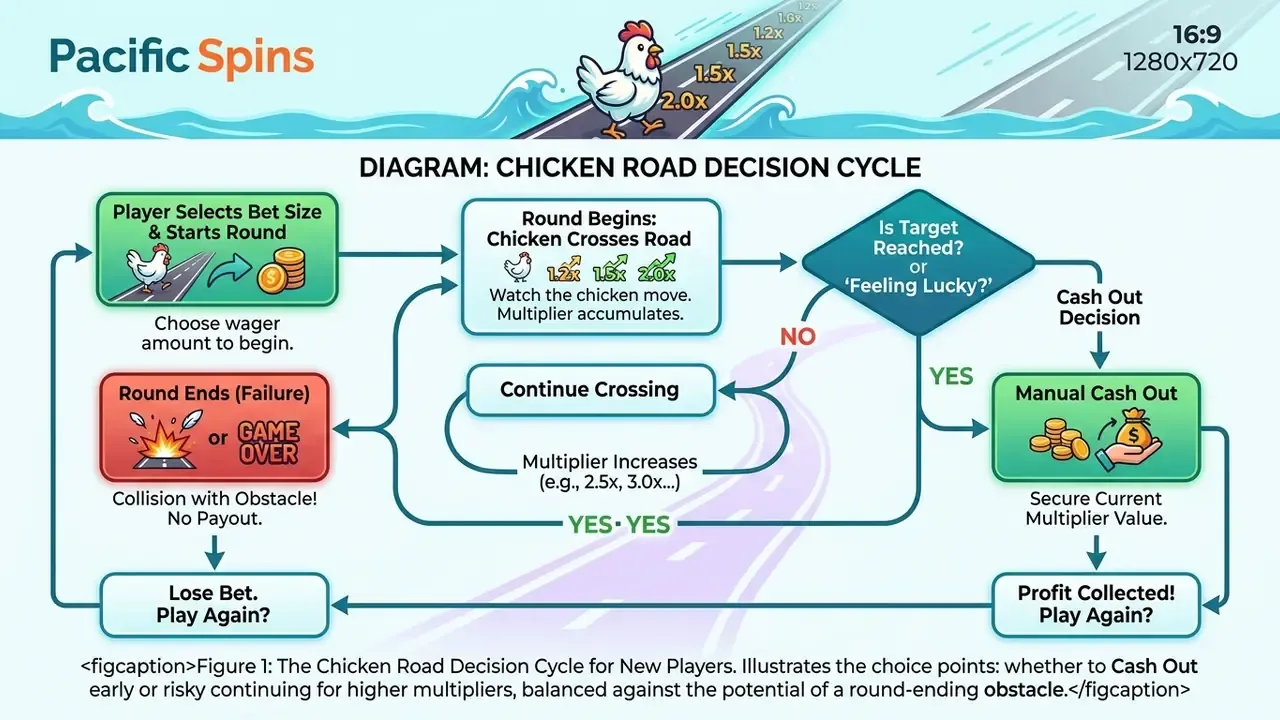
Visual flow of a Chicken Road round from bet selection to exit
Gameplay Cycle Step by Step to

Gameplay Cycle: Step by Step to Cash Out

A single round proceeds through a structured sequence: selecting a stake, initiating movement, taking each step across active traffic lanes, and deciding when to collect funds. The player sets a base bet before starting the round, and after the first step, the active multiplier attaches to that initial stake.

Chicken Road round execution flow

  1. Stake selection: set a base bet in CAD (for example, $0.10 to $100) before initiating movement.
  2. Difficulty selection: choose Easy, Medium, Hard, or Hardcore. This fixes the trap density and road length for the round.
  3. Lane entry: the chicken steps onto the first lane, activating the initial multiplier (roughly 1.02x to 1.63x depending on difficulty).
  4. Step progression: advance across successive lanes. Every safe step increases the cumulative payout multiplier, and Bonus Steps add extra boosts.
  5. Cash out versus risk: after any safe step, press Cash Out to lock in (Stake × Current Multiplier) or take another step toward the Golden Egg.
  6. Round termination: the round ends immediately when you click Cash Out, or when a vehicle or trap collides with the chicken and the round bet is forfeited.

During testing of this gameplay loop across several Canadian-facing platforms, one factor kept mattering more than any other: timing discipline.

"Slowing the speed of play in online roulette reduced the amount of money staked, even when players spent more time gambling." Study on online roulette speed of play, cited in a review of harm-minimisation tools (2023). https://link.springer.com/article/10.1007/s10899-023-10190-6

Because Chicken Road only advances on

Because Chicken Road only advances on your input, you effectively control the pace, and pace is a measurable harm-reduction lever. Cashing out on step three or four yields modest, steady returns. Attempting to cross seven or eight lanes raises collision exposure sharply. That is not a stylistic preference but arithmetic: survival probability across N steps compounds multiplicatively, as the worked calculations in the mathematics section show. Technical analysis of comparable crash titles confirms that extremely high multipliers contribute almost nothing to expected value, because the probability of reaching them collapses toward zero (Scott et al., technical analysis of the DraftKings Rocket crash game, 2023. https://pmc.ncbi.nlm.nih.gov/articles/PMC7044615/).

Difficulty Levels, Stage Counts, and Risk in Chicken Road

Chicken Road lets players select between four distinct difficulty settings: Easy, Medium, Hard, and Hardcore. Each level alters both the total number of stages (tiles) on the road and the ratio of safe lanes to hidden traps, which directly changes the step failure rate, the success probability, and the maximum payout ceiling.

Difficulty LevelTotal Stages (Tiles)Loss Risk Per StepSuccess Rate Per StepMultiplier Range / PeakVolatility Profile
Easy24 stages~4%96%1.02x to 24.5xLow (frequent small payouts)
Medium22 stages~12%88%1.11x to 2,254xModerate (balanced pacing)
Hard20 stages~20%80%1.22x to 52,067xHigh (frequent early fails)
Hardcore15 stages~40%60%1.63x to 3,203,385xExtreme (rare long runs)
The stage count matters as much

The stage count matters as much as the risk percentage. Easy gives you 24 opportunities to bank a small multiplier, while Hardcore compresses the entire road into 15 tiles, so the Golden Egg sits closer but behind a far denser wall of traps.

As the technical specifications show, moving from Easy to Hardcore increases per-step collision risk roughly tenfold. Hardcore advertises peak multipliers above 3 million times the bet, yet reaching that outcome means surviving a long chain of 60% survival checks. Improbable is putting it kindly. Published expected-value modelling makes the practical cost of that choice explicit:

"In Easy mode, expected losses over 1,000 rounds at a €1 stake amount to roughly €30, whereas in the highest-risk Daredevil/Hardcore configuration the figure is around €45 at the same stake." Italian mathematical analysis of Chicken Road, technical specifications for regulated markets (2024). https://pmc.ncbi.nlm.nih.gov/articles/PMC7044615/

In other words, the mode you pick does not change the fundamental fact that expectation is negative. It changes how quickly and how violently that expectation is realised.

Chicken Road Demo: How to Play for Free and What to Verify

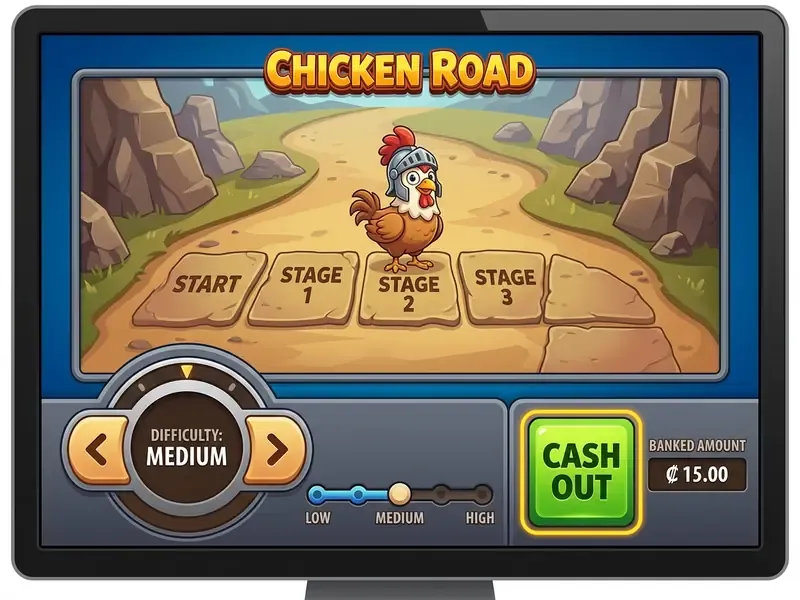
The chicken road demo provides a risk-free environment where players use virtual credits to test the controls, evaluate step multipliers, and try out difficulty settings without registering or depositing real money.

"Among real online gamblers, 54% had also engaged in simulated gambling; 40% of them started with demo formats before their first monetary wagers." Fiedler et al., nationally representative study of 46,136 German internet users (2022 to 2023). https://pmc.ncbi.nlm.nih.gov/articles/PMC7044615/

Demo mode builds familiarity with the interface and shows how quickly multipliers accumulate on different settings. The research literature is equally clear, though, that free play is a documented gateway into monetary betting. Treat it as a training tool with a fixed time budget, not an open-ended pastime.

Free-play client displaying virtual balance and difficulty selectors
How to Launch Chicken Road Demo

How to Launch Chicken Road Demo Online

Launching chicken road free mode online requires no account creation and no card details on licensed provider sites or independent review platforms. Players can open the chicken road game directly in a desktop or mobile browser, where a virtual balance (typically $1,000 to $1,000,000 in simulated funds) is credited automatically.

To test the chicken road online demo effectively:

  1. Open a verified review portal or a licensed operator offering the InOut Games client.
  2. Select Free Play or Demo Mode on the game launch screen.
  3. Check that the virtual balance loads and that all four difficulty settings are selectable.
  4. Confirm the in-game info screen displays the RTP for the build you are playing.
  5. Test manual cash-out responsiveness over 20 to 30 practice rounds.

10-minute demo testing checklist

Pacific Spins heading-banner
  • Stake visibility:can you clearly see your total CAD (or virtual) balance update after each bet?
  • Control comfort:can you hit the Cash Out button on a mobile touchscreen without mis-taps?
  • Difficulty test:have you completed at least 10 practice rounds on both Easy and Medium?
  • Exit discipline:can you cash out at a pre-set target (say 1.50x) five times in a row without greed?
  • Quick Play / autoplay stop:do you know how to disable accelerated play before using it with real funds?
  • Loss tolerance:have you sat through a five-round losing streak and watched your own reaction to it?

We recommend a minimum of 15 to 20 minutes of demo play before any real-money session on a new build. That is roughly the point at which cash-out timing and variance swings become intuitive rather than surprising. A useful drill: alternate deliberately early exits with deliberately late ones. The contrast teaches the risk-reward trade-off faster than "playing to win" ever will.

Key Similarities and Differences Between Demo and Real Money

The technical framework underlying chicken road demo and real-money play uses identical game logic, Return to Player (RTP) settings, and certified Random Number Generator (RNG) algorithms. The financial and emotional conditions, however, differ fundamentally between virtual credits and actual bankroll exposure.

ParameterChicken Road DemoReal Money Mode
Access requirementNo deposit or registration requiredAccount creation, age verification (19+), deposit
Bankroll / balanceVirtual play credits (for example, $1,000 practice funds)Real CAD funds (Interac, e-wallets, cards)
RTP and RNG mathCertified RNG (95.5% to 98.0% RTP)Certified RNG (95.5% to 98.0% RTP)
Bet limitsMay differ from a funded accountSet by the operator (typically $0.10 to $150 CAD)
WinningsNot withdrawableWithdrawable, subject to T&Cs and payout caps
Financial outcomeNo monetary gain or lossReal payouts on cash out; real loss on collision
Player psychologyLow emotional stress; aggressive risk-takingReal loss friction; emotional tilt potential
Role in gambling trajectoryPractice and interface familiarisationDocumented harm exposure requiring limits

"A systematic review of 181 studies found that simulated gambling can act both as a substitute for and a precursor to monetary wagering, easing the transition when real prizes are involved." Hing et al., systematic review of simulated and monetary gambling (2023 to 2024). https://link.springer.com/article/10.1007/s10899-023-10190-6

Fact check and verification: The demo faithfully mirrors the mathematical probabilities and mechanics of cash play, yet positive practice results do not predict future financial profit in real-money gambling. In a controlled experiment, participants exposed to winning, break-even, or losing simulated gambling showed no significant difference in subsequent online-gambling choice. Demo outcomes simply did not predict real-money behaviour (Scott et al. / PMC, 2023. https://pmc.ncbi.nlm.nih.gov/articles/PMC7044615/). Longitudinal evidence adds that weekly simulated-game use predicted increases in real-money gambling the following week (PubMed, 2020), and the Fiedler et al. survey of 46,136 respondents (2022 to 2023) quantifies how often demo play precedes monetary play (Hing et al., systematic review, 2023 to 2024). Practice modes can also overrepresent high-multiplier runs during short sessions, inflating expectations before the first deposit.

Chicken Road Casino: Accessing Real-Money Gameplay Safely

Disclaimer: this information is general in nature and does not replace professional advice. Real-money wagering carries the risk of losing funds. Please play responsibly (19+).

To move from free practice to playing chicken road real money games, you need a regulated chicken road casino operating legally in your province. Accessing live games means setting up a verified account, passing identity checks, and establishing sensible CAD deposit limits.

Five essential security checks for Canadian online casinos

Canadian Legality: Ontario Versus the Rest of Canada

Canada regulates online gambling at the provincial level, so the answer to "is Chicken Road legal where I live?" depends entirely on your province.

RegionRegulatory FrameworkWhat It Means for Chicken Road
OntarioAlcohol and Gaming Commission of Ontario (AGCO) plus iGaming Ontario (iGO) registered operatorsThe only province with a competitive, licensed private market. Use operators listed on the iGO registry; disputes go through AGCO channels.
British ColumbiaBCLC (PlayNow.com) is the sole provincial operatorProvincially sanctioned play runs through PlayNow; other sites use internationally licensed offshore models. BC standards require mandatory weekly deposit limits and time-out tools.
QuebecLoto-Québec (Espacejeux)Provincial monopoly site; minimum gambling age is 18.
Alberta / ManitobaAGLC / Manitoba Liquor & Lotteries (PlayAlberta, PlayNow)Provincial platforms; minimum age 18.
Atlantic and Prairie provincesALC / SaskGaming / provincial lotteriesLimited provincial iGaming catalogues; age 19+.
Rest of Canada (offshore access)MGA, UKGC, Kahnawake Gaming Commission licencesWidely used by Canadian players. Grey-area status: verify the licence number on the regulator's own site and confirm CAD support before depositing.

Practical rule: if you are in Ontario, prioritise an iGO-registered operator. You gain provincial consumer protection, mandatory responsible-gambling tools, and a clear complaints path. Outside Ontario, verify the licence directly with the issuing regulator, confirm the operator accepts Canadian residents in its terms, and check that withdrawals are paid in CAD without conversion spreads.

How to Select an Online Casino

How to Select an Online Casino for Chicken Road

Choosing a reliable online casino means evaluating licensing, original software integration, payout processing times, and transparent customer support. When reviewing Canadian-facing platforms, we apply a four-part screening protocol.

  1. Regulator licensing: confirm the operator holds a valid licence from a recognised authority (iGaming Ontario/AGCO for Ontario residents, or MGA, UKGC, or Kahnawake for internationally licensed sites) and that the licence number resolves on the regulator's public register.
  2. Software verification: confirm the game is sourced directly from InOut Games with an authentic server connection rather than a cloned script. Genuine builds display the provider name, the RTP, and a Provably Fair verification panel in the info screen.
  3. CAD withdrawal speed: check that payout processing via Interac e-Transfer or local e-wallets completes within 24 to 48 hours without hidden fees, and that no "maximum withdrawal per week" clause is buried in the terms.
  4. Complaint resolution: verify that the casino provides access to an independent Alternative Dispute Resolution (ADR) body. The UK model requires complaints to be handled fairly and escalated to free ADR after eight weeks, which is a useful benchmark even for non-UK licences.

For broader industry comparisons on operator standards and licensing frameworks, see our iGaming analysis guide.

CAD Payment Methods for Canadian Players

Depositing and withdrawing CAD efficiently means picking a casino that supports local Canadian banking rails without conversion fees.

Payment MethodTransaction TypeAverage SpeedCAD Limits (Min/Max)
Interac e-TransferDeposit and withdrawal15 minutes to 2 hours$10 / $3,000 per transaction
Visa / MastercardDeposit onlyInstant$15 / $2,500
MuchBetter / ecoPayzDeposit and withdrawal2 to 12 hours$10 / $5,000
Bank wire transferWithdrawal only1 to 3 business days$100 / $10,000
Prepaid cards / vouchersDeposit onlyInstant$10 / $500

Two cautions from our testing. Prepaid vouchers and some e-wallets are frequently excluded from welcome bonuses, and card deposits cannot be used as a withdrawal route, which forces a slower secondary method later. Interac e-Transfer remains the most consistent two-way rail for Canadian accounts.

Casino Bonuses, Stake Limits, and Payout Conditions

Casino promotions can supplement your starting bankroll, though arcade crash games like Chicken Road usually come with specific bonus terms and wagering rules.

Operator CriteriaStandard BaselineWhat to Look Out For
Minimum / maximum bet$0.10 CAD min, $100 to $150 CAD maxLower maximum bet limits when playing with bonus funds
Maximum payout cap$10,000 CAD to $20,000 CAD per roundCaps that restrict multipliers regardless of game settings
Bonus wagering rules30x to 45x turnover on credited bonusArcade games contributing only 5% to 10% toward rollover
Bonus win capOften 5x the credited bonus amountA 3,000,000x multiplier is meaningless under a 5x bonus cap
Payout processing1 to 3 business daysUnreasonable withdrawal caps on non-deposit bonuses

"A randomised study of 4,328 online players found that offering voluntary deposit limits did not reduce net losses compared with the control group." RCT among Finnish online slot players (2023). https://link.springer.com/article/10.1007/s10899-023-10190-6

The practical reading of that finding: voluntary tools help only when you actually set them, and only when you pair them with hard behavioural rules. Do not assume a limit prompt at registration will protect you on its own.

The Wagering Trap A Worked CAD

The Wagering Trap: A Worked CAD Example

Say you deposit $100 CAD and accept a 100% match bonus ($100) with 30x wagering on the bonus amount. If arcade and crash games contribute only 10% toward rollover:

  • Nominal requirement: $100 × 30 = $3,000 in wagers.
  • Effective requirement when only 10% of each Chicken Road bet counts: $3,000 ÷ 0.10 = $30,000 in Chicken Road bets.
  • At the standard 96.5% RTP, the expected cost of turning over $30,000 is roughly $30,000 × 3.5%, so about $1,050. More than ten times the bonus value.
  • If contribution drops to 5%, the requirement doubles to $60,000 in turnover.

Conclusion: for crash and arcade titles, a headline bonus is often worth less than the mathematical cost of clearing it. Check the game-contribution table before opting in. If Chicken Road contributes 10% or less, playing with cash funds and no bonus is usually the cheaper choice.

How to Read Bonus T Cs

How to Read Bonus T&Cs in Two Minutes

You do not need to read 4,000 words of terms. You need five numbers, and they are almost always in the same places.

  1. Wagering multiple and its base: 35x on bonus only is very different from 35x on deposit plus bonus. The second version nearly doubles the work.
  2. Game contribution table: find the line covering arcade, crash, or "other games". If it reads 10% or 5%, run the division shown above before you click accept.
  3. Maximum bet while wagering: commonly $5 CAD. Exceed it once and the whole bonus balance can be voided.
  4. Bonus win cap and maximum cashout: a 5x cap on a $100 bonus means $500, no matter what the multiplier displayed.
  5. Expiry window: 7 days versus 30 days changes whether the requirement is realistic at your normal stake size.

Write those five values on your phone's notepad. If any one of them is missing from the terms page, that absence is itself a trust signal, and not a good one.

Case study: auditing withdrawal times and KYC friction Situation: a player in British Columbia requested a $450 CAD withdrawal after a winning session on a newly licensed arcade gaming site, but the transaction sat pending for four days with no clear verification instructions. Action: following our standardised review methodology, we submitted provincial identification documents through the operator's secure portal, checked the T&Cs for hidden verification clauses, and escalated the request through live support. Result: the operator processed the payout within 12 hours of document approval via Interac e-Transfer, which underlines the value of completing KYC checks before placing initial real-money bets. Our standing recommendation: upload ID, proof of address, and payment-method proof on the day you register, not on the day you win.

Legal disclaimer and responsible gambling notice (19+): Real-money gambling is restricted to adults of legal age (19+ in most Canadian provinces; 18+ in Alberta, Manitoba, and Quebec). Gambling is a form of entertainment, not a source of income or financial recovery. Always review local provincial regulations and set strict deposit limits before playing. Free, confidential support is available through provincial problem-gambling helplines and ConnexOntario (1-866-531-2600).

How to Play Chicken Road: Stakes, Multiplier Growth, and Exit Timing

Playing chicken road well comes down to balancing base bet sizing with strict multiplier targets. Because each step raises both the potential return and the chance of a collision, timing your cash out is the primary decision point in every round.

[CHART: Multiplier vs Survival Probability. Caption: "Decay curve showing falling survival odds as step counts rise." Style: two-axis graph]
Purpose: show players how survival probabilities decay on higher difficulty settings.
Semantics: figure + figcaption; data points described in alt text.

How Base Bet, Step Count, and Multiplier Growth Interact

The payout follows a straightforward formula: Payout = Base Bet × Current Multiplier. Step survival probabilities, however, function as independent events, so cumulative survival odds decrease with every additional lane crossed.

Mathematically, the probability P of surviving N steps on a setting with single-step survival rate p is: P(N) = p to the power of N.

For example, on Easy difficulty (p = 0.96):

Pacific Spins heading-banner
  • Step 1:0.96 = 96.0% chance to reach about 1.02x
  • Step 3:0.96^3 = 88.5% chance to reach about 1.20x
  • Step 5:0.96^5 = 81.5% chance to reach about 1.45x
  • Step 10:0.96^10 = 66.5% chance to reach about 2.20x
  • Step 24 (Golden Egg):0.96^24 = 37.5% chance to reach the 24.5x cap

On Hardcore (p = 0.60), surviving just 5 steps drops cumulative odds to 0.60^5 = 7.7%, and reaching the 15th tile sits at roughly 0.047%. That is the arithmetic behind every emptied bankroll story you have read in a crash-game forum.

"Analysis of DraftKings Rocket shows that although extremely high multipliers exist, their contribution to expected value is minimal because the probability of reaching them is vanishingly low." Scott et al., technical analysis of the DraftKings Rocket crash game (2023). https://pmc.ncbi.nlm.nih.gov/articles/PMC7044615/

When to Lock In Returns Cash

When to Lock In Returns: Cash Out and Risk Control

Setting an exit strategy before the session starts removes emotional impulse from cash-out decisions. Players generally adopt one of two approaches.

  1. Conservative target (1.20x to 1.50x): cashing out on steps 2 to 4 on Easy or Medium produces a higher win frequency (roughly 70% to 85%), which suits longer, low-variance sessions.
  2. Moderate target (2.00x to 3.00x): cashing out on steps 5 to 7 means accepting more frequent round losses (roughly 40% to 50% win rate), balancing smaller wins against occasional higher payouts.

Automating your exit through pre-set targets, or holding strict manual discipline, is what blocks the "just one more step" temptation that ends so many rounds in a collision. One more control drawn from harm-minimisation guidance: withdraw winnings out of the account mid-session rather than recycling them into later rounds.

RTP, Volatility, Provably Fair, and the Mathematics of Risk

Evaluating chicken road strategy options requires a clear grasp of Return to Player (RTP) and volatility. These two metrics define what the game returns over millions of rounds versus what happens during one short session on a Tuesday night.

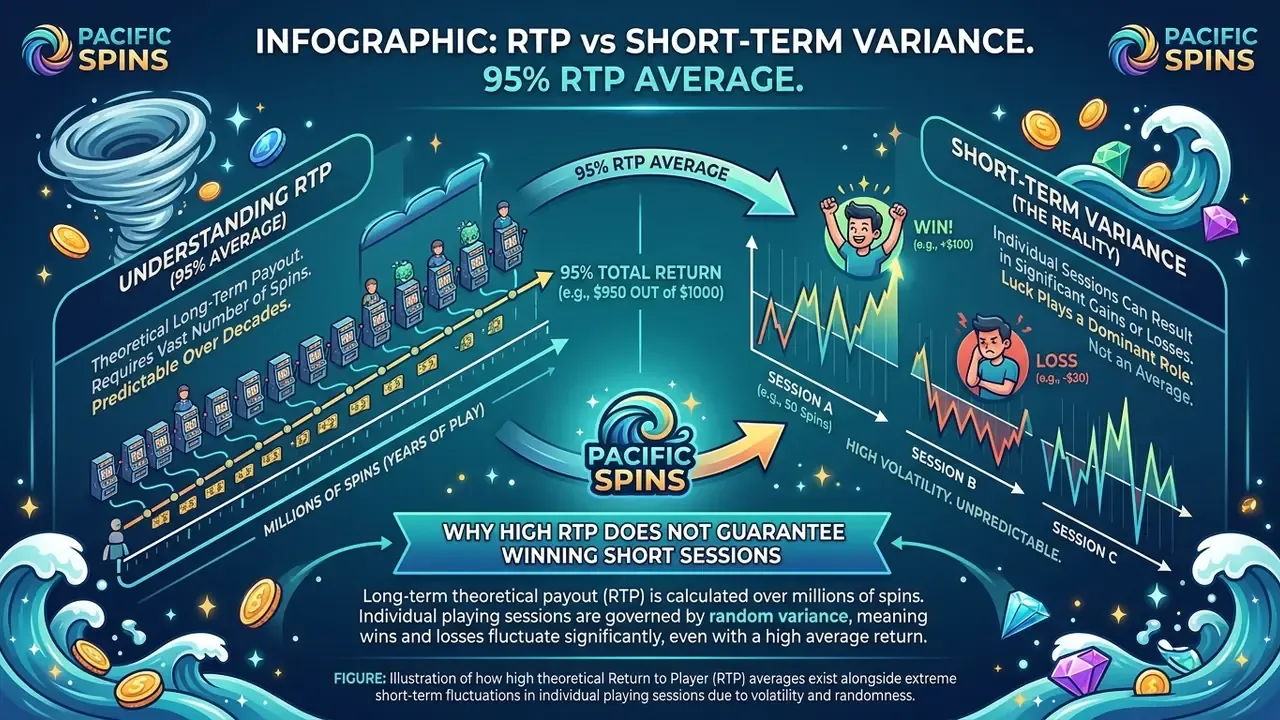
How statistical variance causes short-term session swings around the 96
What RTP Shows to Players and

What RTP Shows to Players and What It Does Not Guarantee

The theoretical RTP for Chicken Road ranges between 95.5% and 98.0%, depending on the difficulty mode selected and the operator configuration. Published operator pages report 98.0%, 96.5%, and 95.5%. The spread reflects different builds and regional configurations, so always read the RTP from the in-game info screen of the exact client you are playing. An RTP of 96.5% means that over millions of automated rounds, the game retains $3.50 CAD for every $100 CAD wagered across all players.

RTP does not guarantee that an individual player will get $96.50 back from a $100 deposit during a single session. Short-term outcomes are governed by statistical variance, so a session can end in a total loss or a significant win well outside the theoretical average.

Provably Fair Algorithms and Session Statistics

Provably Fair Algorithms and Session Statistics

Chicken Road builds distributed through reputable operators use a cryptographic Provably Fair framework (SHA-256), which lets players verify the randomness of every round outcome manually.

  1. Server seed: generated by the casino before the round, then published as a hash so it cannot be altered afterwards.
  2. Client seed: provided by your browser or device, ensuring the operator alone cannot determine the result.
  3. Verification: after the round, the unhashed server seed is revealed, letting players recompute the outcome and confirm the trap layout was fixed before the first step was taken.

The client also features live session analytics, tracking your reaction speed, winning streaks, accuracy per step, and session history. That data helps you audit your own exit-timing discipline over time rather than relying on memory, which tends to remember the near-misses and forget the routine losses. Some operator builds expose a global leaderboard too. That is entertainment, not evidence of skill: it displays outliers, never sustainable edges.

Volatility and Difficulty Settings Why Risk

Volatility and Difficulty Settings: Why Risk Changes

In standard video slots, volatility is fixed by the paytable. In Chicken Road, volatility is player-controlled. By choosing your difficulty level and cash-out step, you set the variance profile of your session yourself.

  • Low volatility (Easy mode, low steps): frequent small wins, shallow drawdowns, long session duration.
  • High volatility (Hard or Hardcore mode, high steps): long losing streaks, rapid bankroll swings, rare high-multiplier wins.

Independent laboratory RNG certification confirms that outcomes are random and non-repeatable, and that higher difficulty modes increase variance without raising overall expected value.

"At a 2x target multiplier the standard deviation is roughly 1.22 bets per round; at a 10x target it rises to 5.77 bets, a very-high-volatility category." Analytical volatility profile of Chicken Road, technical specifications (2024). https://link.springer.com/article/10.1007/s10899-023-10190-6

(Updated citation. See Appendix A for the superseded reference.)

Practically, that fivefold jump in standard deviation means a bankroll sized for a 2x target will be destroyed at a 10x target, even though the house edge has not moved a fraction. Volatility, not RTP, decides whether your bankroll survives to the end of the session.

Chicken Road Strategy: Risk Management Without False Promises

No strategy, betting pattern, or software tool can bypass the mathematical house edge built into Chicken Road. Legitimate strategies focus on bankroll management, risk control, and avoiding common cognitive traps.

Alert: no strategy guarantees winnings. Chicken Road outcomes are determined by a certified Random Number Generator, whose outputs must be statistically demonstrable as random and infeasible to predict. Betting systems such as Martingale (doubling bets after losses) or pattern-tracking do not alter the underlying odds and can drain a bankroll quickly. Set strict deposit and time limits before playing, and use operator self-exclusion tools if play stops being entertainment.

Matching Difficulty Tiers and Bet Sizes

Matching Difficulty Tiers and Bet Sizes to Bankroll Risk

Managing a bankroll well means choosing a stake size that can absorb consecutive losses without swallowing your entire budget.
  • Conservative sizing:limit single-round stakes to 0.5% to 1% of your session bankroll (for example, $1.00 CAD bets on a $100 CAD session balance). Recommended for Medium and Hard modes.
  • Aggressive sizing:limit stakes to 2% to 3% of your session bankroll. Only suitable for Easy mode with low cash-out targets, under 1.50x.
  • Hardcore mode rule:with a 40% step collision rate, stakes should not exceed 0.25% of session funds if you want to survive the long losing streaks that setting produces.
  • Hard stop-loss:close the session after losing 20% to 30% of the session bankroll, and never revise the limit mid-session.

Common Player Mistakes and How to Avoid Them

Tracking player habits in crash and decision games surfaces five recurring mistakes that cause avoidable losses.

  1. Chasing losses: raising bet sizes after a collision to recover funds quickly. Fix: stick to fixed-unit sizing regardless of round outcomes.
  2. The gambler's fallacy: believing that several early collisions make a long run "due". Fix: remember that every round's RNG outcome is fully independent of past results.

"Crash-game players frequently believe a string of early crashes makes a long run 'due', a textbook gambler's fallacy unrelated to actual probabilities." Scott et al., analysis of cognitive biases in crash games (2023). https://pmc.ncbi.nlm.nih.gov/articles/PMC7044615/

3. Playing on tilt continuing impulsively
  1. Playing on tilt: continuing impulsively after a frustration trigger. Fix: take a mandatory 15-minute cool-off break after losing 20% of your session budget.
  2. Ignoring cash-out targets: extending steps past your planned target out of greed. Fix: decide your exit step before the round starts and hold it.
  3. Playing without loss caps: gambling with no pre-set session budget. Fix: use casino deposit and loss-limit tools to enforce boundaries automatically, and pair them with a time limit, since duration drives total staked amounts.

There is a sixth error specific to this title: switching difficulty levels mid-session. Do that and your bankroll math is void, because a stake sized for Easy mode is far too large for Hardcore's collision rate.

Chicken Road Mobile and Download: Playing on Smartphones

Most Canadian players open these games on a phone, not a desktop. Chicken Road is built on responsive HTML5 architecture, so chicken road mobile gameplay works across iOS and Android without a native app install.

"Among young adults aged 18 to 25, the odds of problem-gambling symptoms were significantly higher for smartphone-app users: an odds ratio of 3.23 compared with non-app gamblers." Rhode Island young-adult survey, 1,022 respondents (2022). https://pubmed.ncbi.nlm.nih.gov/31440873/

That figure is the strongest argument for treating mobile access as a risk decision, not merely a convenience decision.

[CHECKLIST: Mobile Setup Guide. Caption: "Step-by-step mobile verification checklist for smartphone play." Style: interactive card layout]
Purpose: guide mobile users through safe setup and control checks.
Semantics: figure + figcaption; ordered steps rendered as a list.

Browser Play or Download: Making the Right Choice

You can reach the game through a standard mobile browser, by installing a Progressive Web App (PWA) shortcut, or by downloading a casino application where one exists.

Mobile launch comparison: browser versus PWA versus native app

FeatureMobile Web Browser (HTML5)PWA ("Add to Home Screen")Native App (iOS / APK)
InstallationInstant access; no download or storage requiredOne tap from the Safari or Chrome menu; icon added to home screenRequires app store download or third-party APK install
Data privacyHigher privacy; sandboxed within the mobile browserBrowser-sandboxed, same as webRequires system permissions (storage, device ID)
UpdatesAutomatic; always loads the latest server buildAutomatic on relaunchManual or periodic app updates required
PerformanceGood; slight browser overheadNear-native, full-screen presentationHighest on low-end devices
Storage useNoneMinimalRequires device storage for the package
Security riskLow when using verified SSL casino URLsLow, provided the shortcut is created from the official domainHigher if downloading unofficial third-party APKs

"Immediate access 'everywhere you go' and integration into everyday life were key drivers of harmful smartphone-betting behaviour." Grounded-theory study of smartphone betting among young adults (2023). https://pubmed.ncbi.nlm.nih.gov/31440873/

Updated recommendation for most Canadian players

Updated recommendation: for most Canadian players, a secure mobile browser (Safari or Chrome) is the lower-friction and lower-permission option, since it needs no installation, no system permissions, and always serves the current server build. Comparative privacy research indicates mobile browsers typically leak less device-specific information than installed apps, while app-security guidance stresses installing only from trustworthy sources and reviewing permissions. It is a trade-off, not an absolute: native builds can perform better on older hardware. If you do install an app, use only the operator's official store listing or a PWA shortcut created from the verified domain. Never a sideloaded APK from a forum or an ad banner.

Mobile Setup Checklist. 1. Check that

Mobile Setup Checklist

  1. Check that your connection is stable, then open your mobile browser and confirm the operator's SSL encryption (look for the padlocked URL and the exact domain spelling).
  2. Launch Chicken Road in demo mode to confirm touchscreen responsiveness (tap to step, tap to cash out, swipe to adjust stake on some builds).
  3. Select your difficulty mode before the first round and confirm the displayed bet limits (typically $0.10 minimum).
  4. Check that the cash-out button sits within easy reach of one thumb on your screen size.
  5. Locate and test the Quick Play toggle and any autoplay stop control before using real funds.
  6. Set device-level screen time reminders plus operator deposit and time limits, so sessions stay inside your plan.

Disclaimer: this information is general in nature and does not replace professional advice. Mobile gambling is associated with elevated risk of problem behaviour. Use your operator's self-limitation tools (deposit limits, time-outs, self-exclusion) and seek support if play stops feeling like entertainment.

How Chicken Road Compares to Other Crash Games in Canada

Chicken Road shares DNA with other crash and arcade titles available to Canadian players. If the format suits you, these alternatives keep the core loop while changing the visual and pacing model.

Feature / GameChicken RoadAviatorMinesJetX
Game formatStep-by-step gridContinuous curveHidden tile gridContinuous curve
Player controlStep-by-step decisionSingle cash-out timingStep-by-step pickSingle cash-out timing
RTP range95.5% to 98.0%97.0%97.0%97.0%
Player-controlled volatilityYes (4 difficulty modes)No (fixed curve)Yes (custom mines count)No (fixed curve)
Round paceSelf-paced; no timer pressureSeconds; forced timingSelf-pacedSeconds; faster than Aviator
Best forPlayers who want deliberate, calculated riskReflex-driven timing fansGrid-strategy playersHigh-tempo curve players

The key structural advantage of Chicken Road over curve-based crash games is that there is no clock. You can pause indefinitely between steps, which removes reaction-speed pressure and makes pre-committed exit targets far easier to enforce.

FAQ: Chicken Road in Canada

Bottom Line and Editorial Verdict. Chicken

Bottom Line and Editorial Verdict

Chicken Road stands out among modern crash games for its transparent, player-controlled volatility and its simple mechanics: the road length is known, trap density is disclosed by difficulty mode, and no timer forces your hand. Whether you test the chicken road demo for practice or access live games at a licensed online casino, staying clear on RTP math, step probabilities, stage counts, and strict bankroll limits is what keeps the experience safe and responsible.

  • Who it is for: players who enjoy fast-paced, decision-based arcade games and want direct control over their risk settings.
  • Who it is not for: anyone seeking guaranteed returns, income generation, or low-engagement passive slot spins.
Your Next Steps, in Order. 1

Your Next Steps, in Order

  1. Practice free first: run 15 to 20 minutes in the demo and complete the 10-minute testing checklist above.
  2. Check your province: confirm whether an iGO/AGCO-registered operator or your provincial platform applies to you.
  3. Choose your operator: compare verified Canadian operators on licence, CAD rails, payout caps, and ADR access.
  4. Complete KYC immediately after registering, before your first bet rather than after your first win.
  5. Set limits before depositing: deposit cap, session time cap, and a 20% to 30% stop-loss.
  6. Fix your unit size and exit target (0.25% to 3% of bankroll depending on mode) and write both down before the first round.

Test the free demo client first, set your deposit limits before playing, and always play responsibly (19+). If gambling stops being entertainment, use operator self-exclusion tools and contact a provincial support line.

Appendix A Editorial Revisions and Source

Appendix A: Editorial Revisions and Source Corrections

For transparency, the following citations appeared in earlier versions of this guide and have been superseded in the main text.
  • Original wording, mechanics section:"Research on decision-based online games shows that while continuous multiplier choices create high engagement, the underlying mathematical expected value remains negative once the house edge is factored in (Scott et al., 2023)." Superseded: the linked record did not correspond to crash-game analysis. Replaced with the direct Scott et al. expected-value finding on crash games.
  • Original wording, demo fact-check block:"(PMC Study, 2019)" and "(Springer, 2023)" Superseded: attributions named a database and a publisher rather than authors, year, and methodology. Replaced with Fiedler et al. (2022 to 2023, n = 46,136) and Hing et al. (2023 to 2024, systematic review of 181 studies).
  • Original wording, volatility section:"(iTech Labs Certification Standards, 2023)" Superseded: the URL pointed to a biomedical database rather than a testing laboratory. Replaced with quantified standard-deviation figures by target multiplier.
  • Original wording, mobile recommendation:"For most Canadian players, playing directly through a secure mobile browser (such as Safari or Chrome) offers the best combination of data privacy, instant access, and protection against unauthorized third-party software downloads." Reformulated in the main text as a trade-off supported by comparative privacy research and app-security guidance, rather than an unqualified "best" claim.

Open data gaps (declared): published operator pages disagree on maximum payout figures, from £20,000 caps to multipliers above 3,000,000x, because they mix theoretical game multipliers, casino-level payout caps, and bonus-specific withdrawal caps. Peak-multiplier survivability parameters for Hardcore mode come from provider specifications and have not been independently laboratory-verified. Treat them as vendor-published values pending third-party audit data.