
“Navigating online poker in Canada requires looking beyond promotional headlines to inspect licensing, RNG fairness, and exact withdrawal terms. A player deserves a clear, plain-English breakdown of game mechanics, hand rankings, and bankroll risks before making their first deposit.” , Reid Calloway, Independent Online-Casino Analyst (Vancouver, BC), editorial persona
Table of ContentCloseOpen
- Why This Matters Before You Deposit
- Four Things to Settle Before Your First Real Money Hand
- What Is Poker Online and How the Game Works
- Poker Rules: Basic Rules for Beginners
- Cash Games and Poker Tournaments: Game Formats and Choosing Your Goal
- Poker Strategy for Your First Hands
- Poker Demo, Free Poker, and Real Money: Which Mode to Choose
- How to Choose a Poker Site and Evaluate Offer Value
- How to Start Playing Poker Online After Choosing a Site
- FAQ: Taxes, Interac, Bots and Player Pools
- Five Mistakes New Players Make in Their First Month
- Conclusion and Summary
- Appendix A: Source Notes and Revisions
Poker Online: Rules, Formats, and Real Money Play
Last updated: January 2026 · Reviewed for Canadian players (19+, or 18+ in Alberta, Manitoba and Quebec)
Online poker is a digital card game format where participants evaluate hand strength, place strategic wagers, and compete either against other players in peer-to-peer (P2P) rooms or against the house at casino-style tables. Entering an online poker table in 2026 means choosing between free-to-play training modes, live dealer broadcasts, and real money cash games or tournaments on provincially regulated or international platforms.
Understanding how poker works online starts with one split: pure player-versus-player (PvP) skill disciplines on one side, house-banked casino variations on the other. Whether you are testing basic card mechanics in a demo room or managing a CAD bankroll through Interac transfers, every hand follows strict mathematical probabilities, structured betting rounds, and codified hand hierarchies.
Why This Matters Before You Deposit
Here is the practical reason to read the mechanics before the marketing. Most complaints from Canadian players are not about bad cards. They are about a withdrawal frozen at verification, a bonus that never released because the rake target was unrealistic, or a “poker” table that turned out to be a house-banked casino game with a fixed paytable.
Three things decide your experience far more than any welcome banner: the licence behind the room, the real payout speed in CAD, and the exact terms attached to the offer. Everything else, table themes, avatars, loyalty badges, is decoration.
So the order of operations matters. Learn the format. Check the licence. Read the terms line by line. Then deposit, with a limit already set.
Four Things to Settle Before Your First Real Money Hand
- Pick the format before the site. Cash games (static blinds, leave anytime, 20 to 30 buy-in bankroll) behave nothing like MTTs (escalating blinds, top-heavy payouts, 50 to 100+ buy-in bankroll). Your format choice dictates your strategy, your session length, and your bankroll math.
- Know who your opponent is. Classic online poker and live dealer poker are equal-chance PvP games where the room only earns rake. Casino Hold’em, Three Card Poker, and Ultimate Texas Hold’em are house-banked games with a permanent mathematical edge for the operator: no bluffing, no peer positioning.
- Verify licensing and payouts, not banners. In Ontario, legal commercial online poker runs under iGaming Ontario and the AGCO with segregated player pools. Elsewhere in Canada, players typically use Kahnawake- or MGA-licensed international pools. Check the RNG certificate (iTech Labs, GLI, eCOGRA) and the exact CAD withdrawal timeline before depositing.
- Bonuses are rake-release mechanisms, not free cash. A “100% up to $600 CAD” poker bonus usually unlocks in increments as you pay rake. Convert the offer into an effective rakeback percentage before judging its value, and always read the wagering timeframe.
What Is Poker Online and How the Game Works
Poker online is a software-mediated adaptation of traditional card games where players connect through desktop clients, web browsers, or mobile apps to join virtual tables. The core mechanism relies on a certified Pseudo-Random Number Generator (PRNG) to shuffle and deal digital cards, while the game engine calculates pot contributions, enforces betting limits, and distributes winnings according to official hand values.
Unlike casino table games such as roulette or blackjack, where participants play against the house edge, classic online poker is a peer-to-peer environment. In this setting, poker is an equal-chance game: players compete directly against one another. The operator takes no financial stake in who wins the hand.
Instead, the platform collects a small service fee known as “rake” from cash game pots, or builds an entry fee into tournament buy-ins.
Players in Canada reach these tables either through provincially regulated or international platforms. Readers comparing regulated environments can review how licensed online casinos structure their poker lobbies, cashiers, and compliance disclosures.
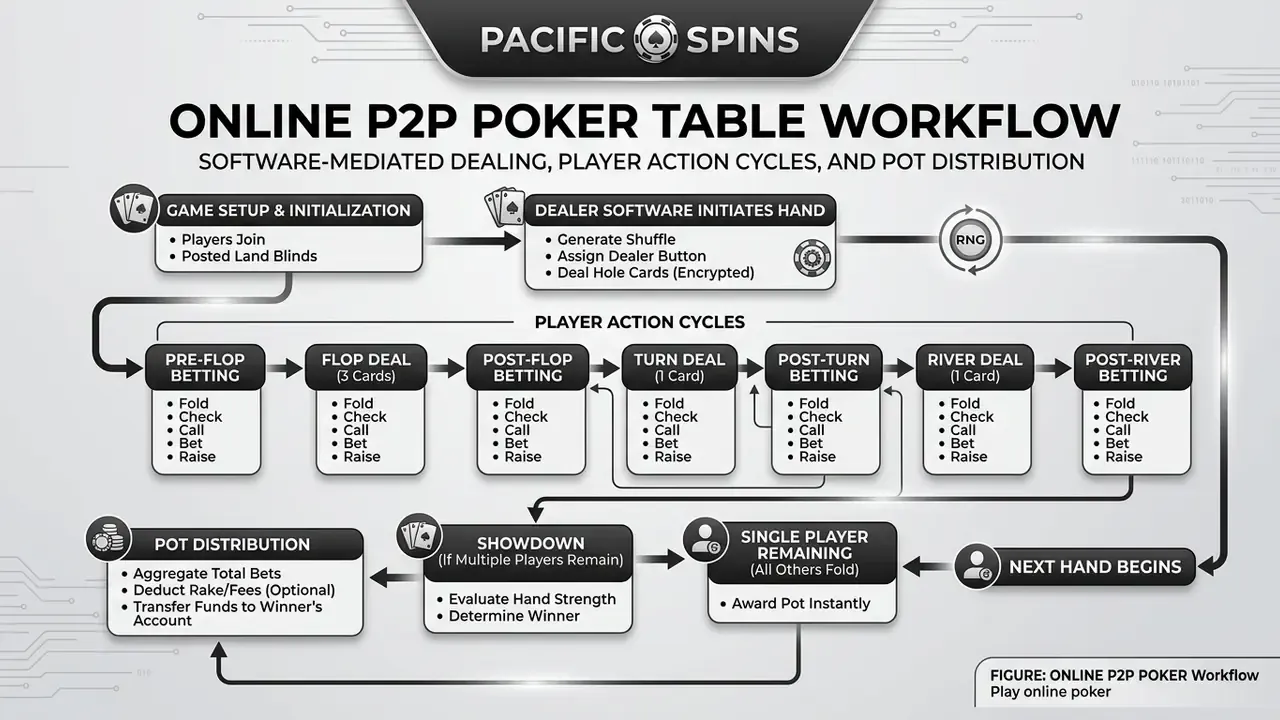

When poker players enter a digital lobby, the software assigns them a virtual seat with visible chip stacks, player handles, and action buttons (Fold, Check, Call, Raise). According to technical standards established for poker state tracking, such as the Poker Hand History specification, every state progression is logged continuously, from pre-flop blinds to river showdowns. That transparent logging is what allows regulators and independent testing labs (eCOGRA, iTech Labs) to audit table integrity and verify that card distribution stays unpredictable and unbiased. Serious operators publish their certificate references openly, and you can cross-check a listed seal against the testing laboratory’s own public register of certified operators before depositing. It takes two minutes. Do it anyway.
Popular Poker Games: Texas Hold’em and Other Variants
Texas Hold’em is the most widely played poker game online, accounting for roughly 70% of all global online poker traffic.
“Texas Hold’em accounts for roughly 70% of hands played across the global online poker market, confirming its central role for new and experienced players.” , Worldmetrics Poker Industry Report (2026). https://worldmetrics.org/poker-industry-statistics/
In Texas Hold’em, each player receives two private hole cards, while five community cards are dealt face-up across three phases: the Flop (three cards), the Turn (one card), and the River (one card). The objective is to build the strongest five-card poker hand using any combination of your two hole cards and the five community cards.
Beyond Hold’em, several other popular poker games draw substantial volume:
- Pot-Limit Omaha (PLO): Each player receives four hole cards but must use exactly two hole cards with exactly three community cards to construct the final five-card hand. Because four hole cards generate six unique two-card combinations, PLO produces far more multi-draw situations and dynamic board textures.
“Cash game win-rate variance in PLO runs approximately 15% higher than in No-Limit Texas Hold’em, driven by the four-card structure and dynamic betting patterns.” , ZipDo Poker Education Reports (2026). https://zipdo.co/statistics/poker/
- Omaha Hi-Lo (8-or-Better): A split-pot variant where the pot is divided 50/50 between the best high hand and the best qualifying low hand (five unpaired cards ranked 8 or lower).
- Short Deck (Six Plus Hold’em): Played with a stripped 36-card deck (cards 2 through 5 removed). With fewer low cards, probabilities shift sharply: a Flush beats a Full House, and an Ace can count as a high card or complete a low straight (A-6-7-8-9).
Several rarer disciplines now appear in the lobbies of major international rooms, and knowing them helps you spot soft, low-competition tables:

- 5-Card and 6-Card PLO (PLO5 / PLO6):High-action Omaha variants dealing five or six private hole cards. Pre-flop equities run extremely close, which produces massive pots and forces players to hold absolute “nut” hands to win at showdown. Several networks added PLO6 and Short Deck tables to their standard cash lobbies during 2025 and 2026.
- Pineapple and Open-Face Chinese (OFC):Variants where players receive three hole cards pre-flop and discard one before the action continues, pushing average hand strengths and post-flop equity collisions upward.
- Seven Card Stud:A classic non-community-card variant where players receive seven individual cards (three face-down, four face-up) to build their best five-card combination. Stud rewards memory and card tracking rather than board-texture reading.
- Mixed rotations (H.O.R.S.E., Hold’em/Omaha mixes):Some rooms alternate disciplines every orbit or level inside a single table, testing breadth of knowledge rather than depth in one game.
Choosing the right discipline depends on your strategic experience and tolerance for variance. Newer players are usually better off starting with No-Limit or Fixed-Limit Texas Hold’em, simply because the educational material is abundant and hand construction is straightforward. Hold’em is the baseline structure. Omaha adds combinatorial complexity and a strict hand-construction constraint. Short Deck adds deck-removal effects and reordered rankings, which makes it the most structurally different of the three.
Poker Live Dealer, Poker Live Casino, and Online Tables with Players
Online platforms separate card games into three delivery formats: automated digital P2P tables, live dealer P2P tables, and live casino games played against the house. Knowing the operational difference keeps you from sitting down at the wrong kind of table, which happens more often than you would think.
- Automated digital P2P poker:You compete exclusively against other human players. Software shuffles and deals instantly. This format offers the fastest tempo (60 to 80 hands per hour on single tables, and 200+ per hour in fast-fold formats), which makes it the primary choice for data-driven strategic poker play.
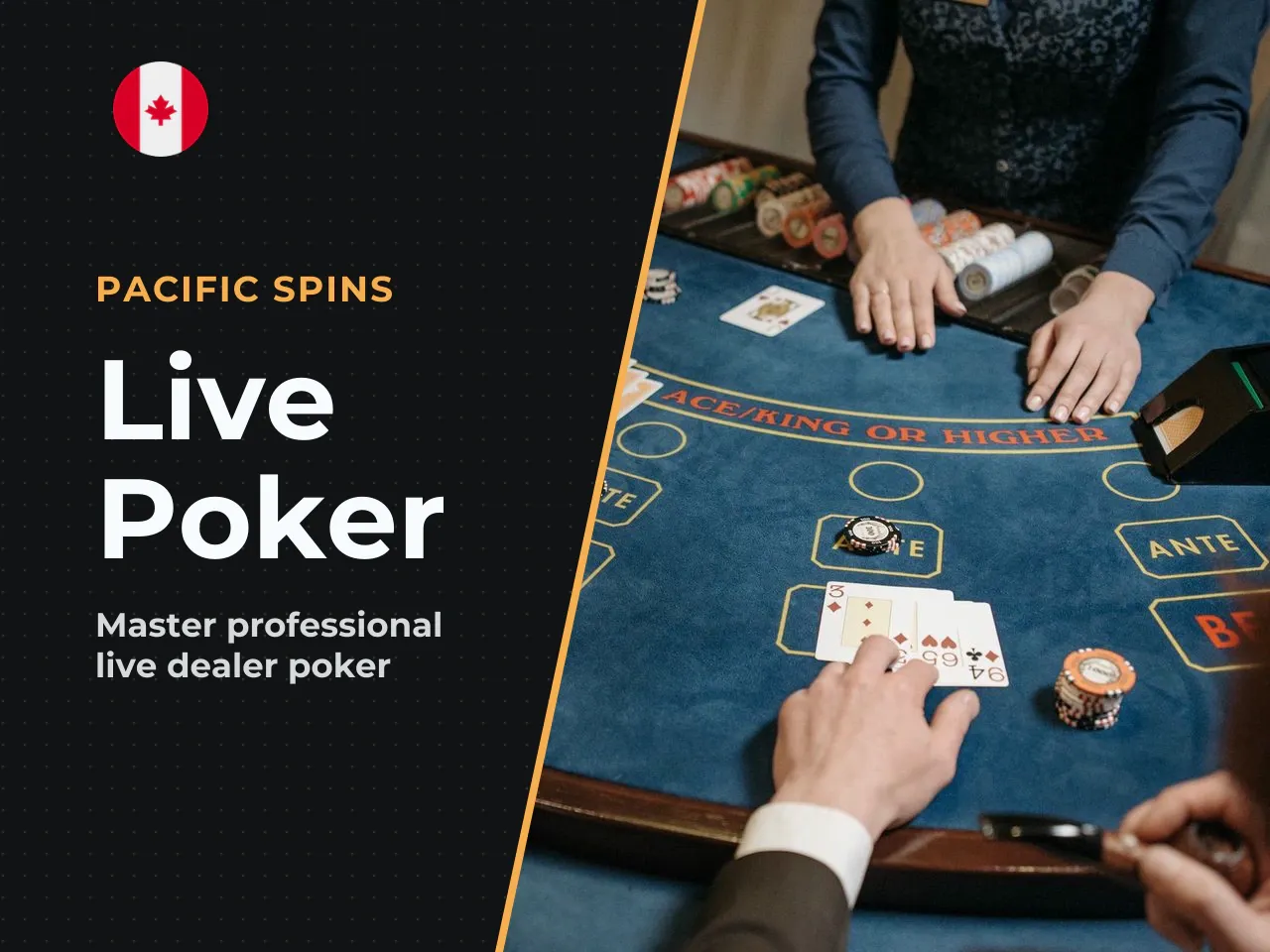
- Poker live dealer (P2P):Real human dealers operate physical tables inside streamed broadcast studios, dealing physical cards while digital overlays record player bets. Equal-chance PvP rules stay intact, but the pace is physical and therefore slower.
- Poker live casino (house-banked):Games such as Casino Hold’em, Three Card Poker, or Ultimate Texas Hold’em put you directly against the live poker casino dealer. Here the casino holds a built-in mathematical edge. Bluffing and peer positioning are absent, because the payout structure relies on fixed odds tables. Regulators formalize this split: “equal chance” poker has players competing against each other, while “non-equal chance” or banked poker inserts the house as an opponent with a mathematical advantage.
Comparative analysis of online poker formats
| Format | Primary Opponent | Role of Dealer | Table Structure and Rake | Pace of Play | Skill Impact |
|---|---|---|---|---|---|
| Standard online poker (RNG) | Other human players (PvP) | Automated software, certified PRNG engine | Equal chance; platform collects pot rake (3% to 5%) or tournament fee | Fast (60 to 200+ hands/hour) | High (position, bluffing, mathematical EV) |
| Poker live dealer (P2P) | Other human players (PvP) | Human physical dealer streamed via video | Equal chance; physical deal tracked by OCR scanner, rake applied | Moderate (30 to 45 hands/hour) | High (standard strategic play at physical pace) |
| Poker live casino (house) | The casino / house | Human dealer representing the casino bank | Non-equal chance; house edge built into paytables, no rake | Slower to moderate (30 to 50 hands/hour) | Low to moderate (fixed odds, no bluffing against peers) |
Poker Rules: Basic Rules for Beginners
The fundamental poker rules ask you to form the strongest possible five-card combination, or to make every opponent fold before the showdown. A standard deal proceeds clockwise around the table, opened by forced bets that seed the pot before any cards appear.
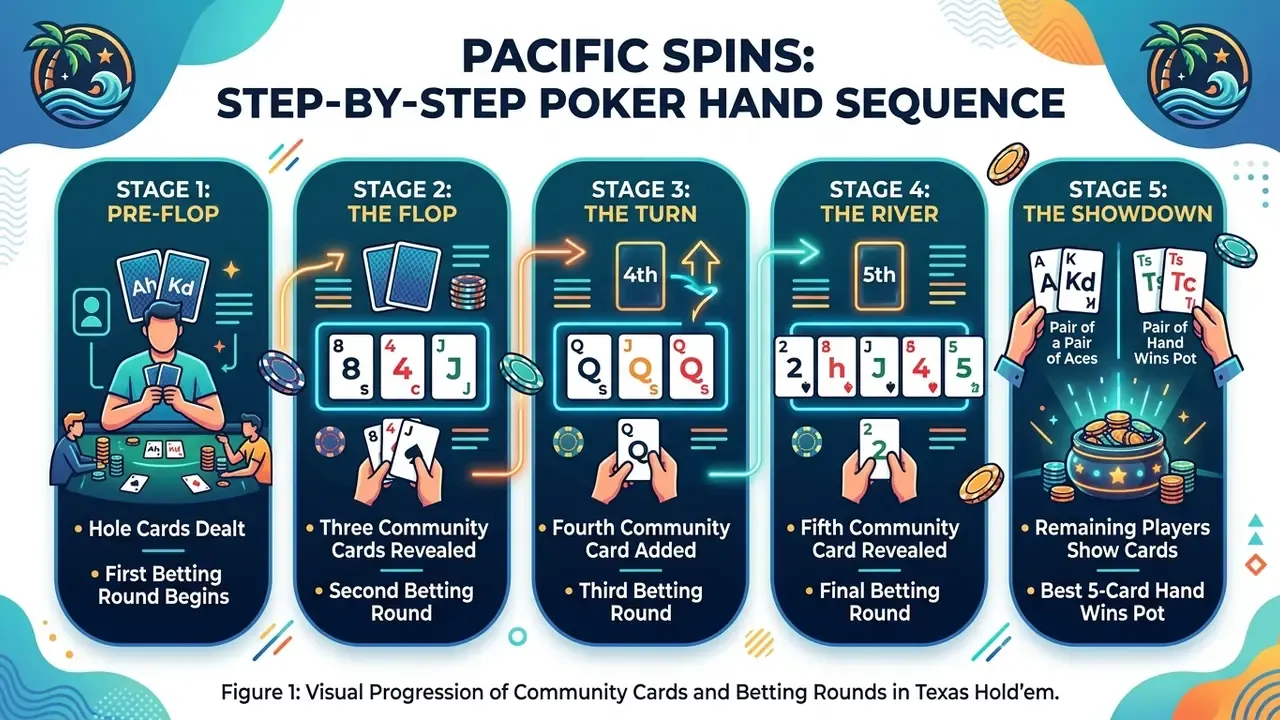
Every standard hand of Texas Hold’em moves through four structured betting rounds:
- Posting blinds: Before any cards are dealt, the two players directly to the left of the dealer button post the Small Blind (SB) and Big Blind (BB). These forced wagers guarantee money in the pot on every hand. The button marks dealer position and moves one seat clockwise after each hand, so positional advantage rotates fairly.
- Pre-flop: Each player is dealt two private hole cards face down. Action starts with the player to the immediate left of the Big Blind (“Under the Gun”) and proceeds clockwise.
- The flop: The dealer exposes three community cards face-up in the centre of the table. A second betting round begins with the first active player seated to the left of the button.
- The turn: A fourth community card is dealt face-up. The third betting round follows the same turn order.
- The river: The fifth and final community card is exposed. The final betting round takes place.
- Showdown: If two or more players remain active after the last wagers are matched, all remaining hole cards are revealed. The highest-ranking five-card hand wins the pot.
During any betting round, players choose from five core actions:

- Fold:Surrender your hole cards and forfeit any claim to the current pot.
- Check:Pass the action along without wagering more chips (permitted only if no bet has been made in the current round).
- Call:Match the highest bet or raise made during the round.
- Raise:Increase the current wager, forcing later players to call the higher amount, raise again, or fold.
- Bet:Place the first wager of a betting round when nobody has bet yet.
Card Combinations and Poker Hand Strength
Deciding the winner at showdown relies on standard five-card hand rankings used across nearly every major poker variant. When two hands fall in the same category, tie-breaker rules compare individual card values (Aces high, down to 2s) and kicker strength.
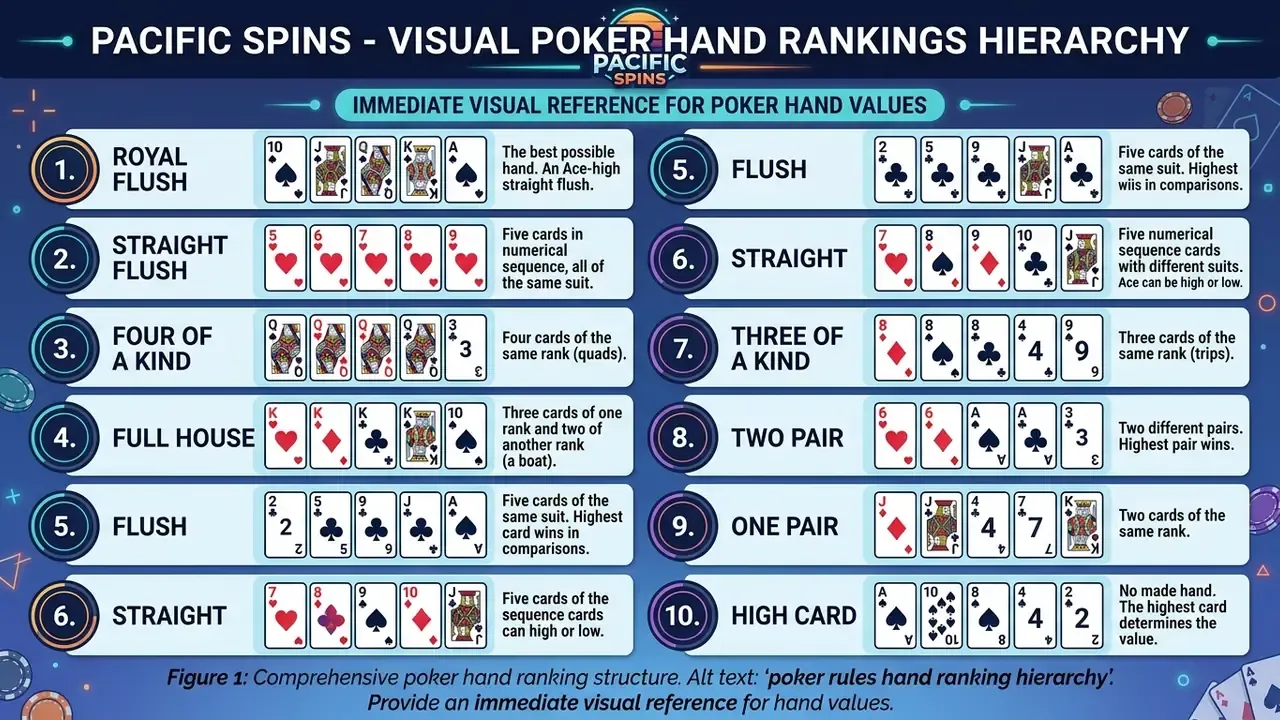

The 10 standard poker hand combinations, ranked from highest (1) to lowest (10):
- Royal Flush: Ace, King, Queen, Jack and 10 of the same suit (for example A♠-K♠-Q♠-J♠-10♠). The highest possible hand.
- Straight Flush: Five consecutive cards of one suit that do not form a Royal Flush (9♥-8♥-7♥-6♥-5♥).
- Four of a Kind (Quads): Four cards of identical rank plus a fifth card, the kicker (8♣-8♦-8♠-8♥-K♦).
- Full House: Three cards of one rank with two of another (J♠-J♦-J♣-4♠-4♥). If two players hold a Full House, the higher three-of-a-kind wins.
- Flush: Five non-consecutive cards of the same suit (A♦-J♦-8♦-4♦-2♦). Ties break on the highest individual card.
- Straight: Five sequential cards across mixed suits (10♠-9♦-8♥-7♣-6♠). An Ace can play high (A-K-Q-J-10) or low (5-4-3-2-A).
- Three of a Kind (Set / Trips): Three cards of equal rank with two unmatched kickers (Q♣-Q♦-Q♠-7♥-2♠).
- Two Pair: Two distinct pairs plus one kicker (K♠-K♥-10♦-10♣-5♥).
- One Pair: Two cards of identical rank with three unmatched kickers (A♦-A♠-9♥-4♣-3♦).
- High Card: Any hand that forms none of the combinations above (A♠-Q♦-9♥-6♣-2♦). Value is set entirely by your highest card.
Kicker and split pot rules: if two players hold the exact same made hand, say Two Pair of Aces and Kings, the fifth card (the kicker) decides it. If all five cards forming the best hand are identical, the pot splits equally. Suits carry no hierarchy in standard poker rules: spades, hearts, diamonds and clubs are equal in value.

Betting, Cash, and Round Structure
Online table betting limits follow three structural frameworks that dictate how money or chips move during a round:
- No-Limit (NL):You may wager any amount up to your entire stack at any point on your turn. No-Limit Hold’em (“NLHE”) is volatile by design, since full stacks can go in pre-flop or post-flop.
- Pot-Limit (PL):The maximum raise is capped by the current pot size, including the call requirement. In Pot-Limit Omaha (“PLO”), the maximum raise equals the current pot plus all active bets on the street plus the amount needed to call.
- Fixed Limit (FL):Bets and raises are restricted to standardized amounts set by room rules for each street. The number of raises per round is usually capped at three or four.
Recent statistical work on game volatility indicates that No-Limit structures increase stack volatility by roughly 25% compared with Fixed-Limit games.
“No-Limit structures increase stack variance by roughly 25% versus Fixed-Limit games; the probability of a pre-flop all-in online sits near 18%, compared with about 12% live.” , ZipDo Poker Education Reports (2026). https://zipdo.co/statistics/poker/
That gap says something about tempo: digital software runs faster and rewards aggression more sharply than a physical card room.
Cash Games and Poker Tournaments: Game Formats and Choosing Your Goal
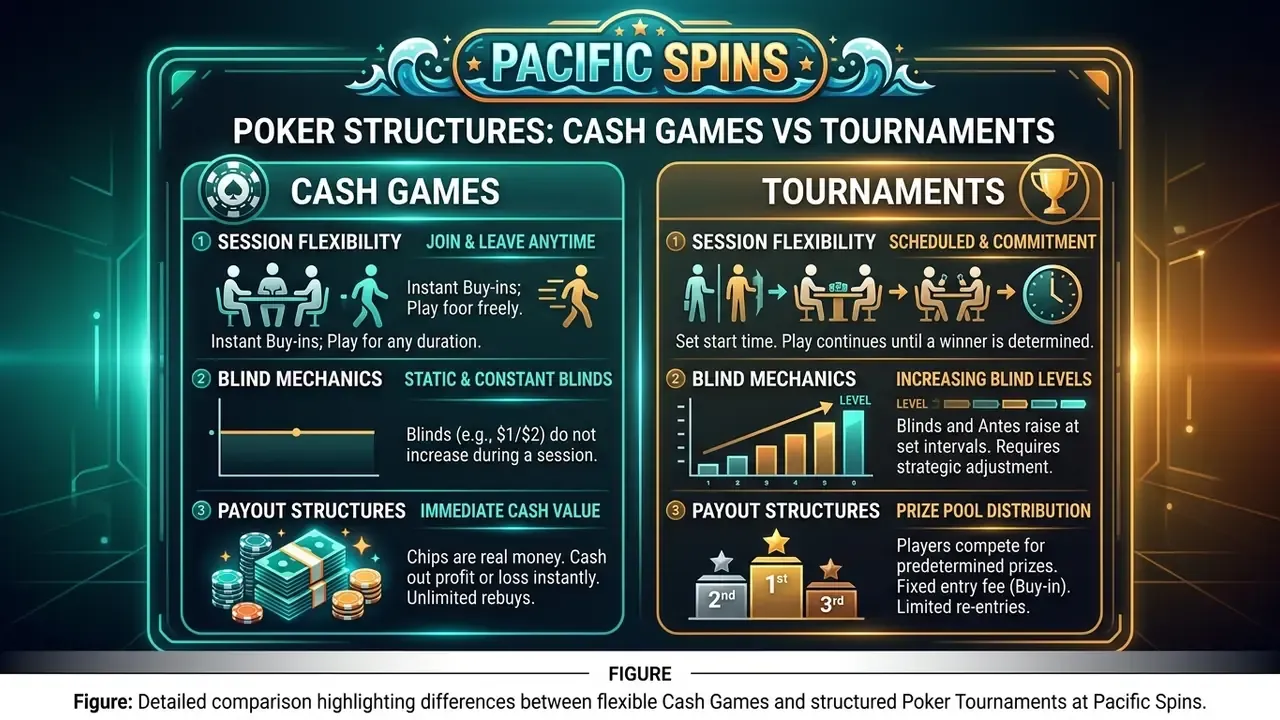
Choosing between cash games and poker tournaments depends on your available time, target win rate, and personal risk profile. Both formats use identical card rankings and betting mechanics, yet their structural rules create very different strategic experiences. Settle this before you register an account, because your format determines the stakes you should target, the bankroll you need, and the strategy you must study.
Cash Games (Ring Games)
In cash games, chips on the table represent exact monetary value (a $1 CAD chip equals $1 CAD).
- Session flexibility:You can join a table, top up your stack, or stand up and cash out at any moment.
- Static blinds:The Small and Big Blinds stay fixed indefinitely, for example $0.50/$1.00 CAD. Stacks stay relatively deep in big-blind terms, which allows complex post-flop play.
- Variance and downswings:Cash games carry lower payout variance than tournaments, and downswings remain manageable under steady, disciplined play.
“Across 847 tracked sessions, 43% of cash-game sessions ended in a loss, with an average losing session of $87 at $0.50/$1 stakes, while tournament entries lost the full buy-in 78% of the time.” , Betting Strategy Case Study Dataset (2023). https://www.bettingstrategy.com/poker-cash-games-vs-tournaments/
Poker Tournaments (MTTs, Sit & Gos, Spin & Gos)
In tournaments, you pay a fixed buy-in for a starting stack of tournament chips. Those chips hold no direct cash value during play. Instead you compete to survive as opponents are eliminated.
- Multi-table tournaments (MTTs):Hundreds or thousands of players compete across many tables. The prize pool goes to the top 10% to 15% of finishers, with the heaviest rewards reserved for the final table.
- Escalating blinds:Blind levels rise on a schedule (every 10 or 15 minutes, typically), shrinking stacks relative to blinds and forcing aggression as the event runs on.
- Sit & Go (SNG):Smaller tournaments that start automatically once a preset number of seats fills, usually 6, 9 or 18 players.
- Freerolls:Tournaments with no buy-in but real prize money, often used by rooms as onboarding tools for new depositors and loyalty-scheme members.
- Variance profile:Tournament outcomes are extreme. Players lose the entire buy-in in roughly 78% of entries and rely on rare deep runs for long-term profit.
“Tournament payout-structure variance runs about 30% higher than cash games; only about 1 in 1,200 entries produces a result equivalent to a 10+ buy-in score.” , ZipDo Poker Education Reports (2026). https://zipdo.co/statistics/poker/

Modern Online Poker Formats: PKO, Mystery Bounty, and Fast-Fold
Alongside traditional freezeout MTTs, modern rooms schedule specialized high-tempo formats that now dominate weekend lobbies:
- Progressive Knockout (PKO):Half the buy-in feeds the regular prize pool, the other half becomes a bounty on your head. Knocking a player out pays you 50% of their bounty in cash immediately, while the remaining 50% is added to your own bounty, which makes late-stage eliminations exponentially lucrative.
- Mystery Bounty:A multi-phase structure where bounty values stay secret until Day 2 or the money stage. Each elimination triggers a randomized prize draw, and a single draw can reach 10% to 15% of the total prize pool.
- Fast-fold poker (Zoom, Snap, Zone):A high-speed cash format. The moment you fold, the software moves you to a new table with new cards and different opponents. No waiting, and speeds of 200 to 300 hands per hour.
- Jackpot Sit & Gos (Spin & Go, BLAST, Windfall):Three-handed hyper-turbos where a multiplier wheel randomly sets the prize pool, from 2x to 10,000x the buy-in, before the first hand.
- Table novelties:Bomb pots, straddles, Run It Twice and anonymous tables appear more and more at international rooms. They reshape variance and pot-size distribution even when the underlying rules stay identical.
| Feature | Cash Games (Ring Games) | Multi-Table Tournaments (MTTs) |
|---|---|---|
| Chip value | Direct cash value (CAD) | Tournament points, no direct cash value |
| Session duration | Completely flexible, leave anytime | Fixed schedule, 2 to 8+ hours until elimination or win |
| Blind levels | Static, never change | Escalating at timed intervals |
| Rebuy mechanics | Reload anytime the stack drops | Restricted (re-entry windows or freezeout) |
| Payout structure | Immediate pot wins | Top-heavy distribution, top 10% to 15% cashed |
| Variance and volatility | Moderate, lower swings | High, extreme swings |
| Recommended bankroll | 20 to 30 buy-ins | 50 to 100+ buy-ins |
Why do so many recreational players still gravitate toward lottery-like tournament formats despite the harsher variance?
“Econometric analysis of real online poker data reveals a robust preference for skewed payout distributions, small chances of very large wins, even at comparable or lower expected value.” , “Skewness Preferences: Evidence from Online Poker,” SSRN preprint (2022). https://papers.ssrn.com/sol3/papers.cfm?abstract_id=4217284
Being aware of that bias is itself an edge. If you knowingly pick Spin & Gos or PKOs for entertainment value, size your bankroll for the skew instead of pretending the variance is not there.
Poker Strategy for Your First Hands
A solid beginner poker strategy comes down to three habits: disciplined decisions, respect for position, and conservative bankroll management.
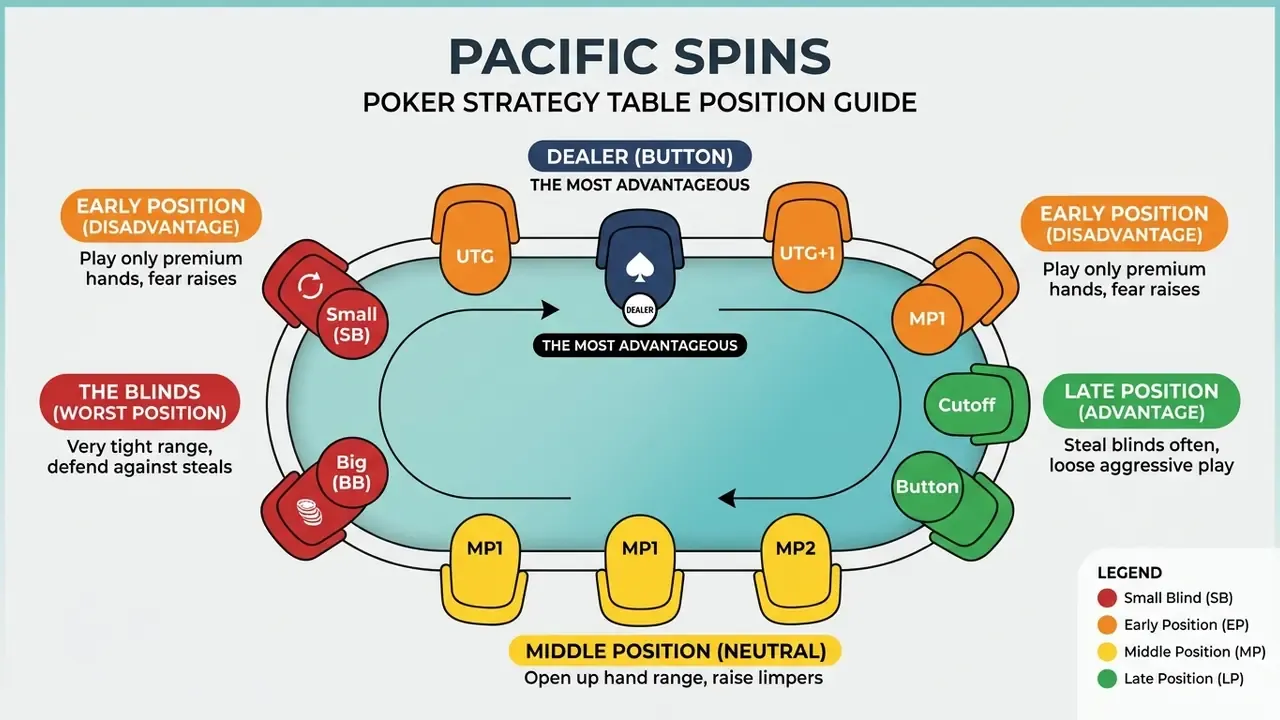
Core Beginner Strategy Principles
- Starting hand selection (tight pre-flop play): Resist playing weak or marginal hands out of curiosity. From early positions, stick to premium holdings: high pairs (A-A, K-K, Q-Q, J-J) and strong broadway combinations (A-K, A-Q). Fewer marginal hands means fewer painful post-flop guesses.
“Skill exerts a significant and persistent effect on results; a novice needs at least seven months of intensive practice to reach the baseline level of experienced players.” , “Dominance of Skill in Online Poker,” peer-reviewed study of 91,439 players and 85M+ hands. https://doi.org/10.1371/journal.pone.0291429

- The power of table position:Position may be the single most valuable free resource at the table. Acting after your opponents on post-flop streets hands you information for nothing. In late position (Button and Cutoff) you can widen your range, because you see how everyone else acts before you commit.
- Playing suited connectors (9♠-8♠, J♥-10♥):These hands shine in multi-way pots thanks to high implied odds. They rarely win unimproved, but their ability to make hidden straights and flushes makes them good candidates for calling raises in position. Example: holding J♣-9♣, a straight flush needs the 10♣ plus two of Q♣/K♣/8♣/7♣ on board. Rare, obviously. The same structure, though, produces frequent and well-disguised straights and flushes.
- Understanding backdoor draws for bluffing:A backdoor draw (runner-runner) needs both the turn and the river to complete, for instance holding two spades when only one spade hits the flop. Use backdoor flush and straight equity as secondary bluffs on the flop: they let you continue aggression credibly on good turn cards while keeping real outs at showdown.
- Post-flop check-raising:Check-raising means checking out of position, then raising after an opponent bets. Save it for your strongest made hands (sets, two pair) to build the pot, or as a semi-bluff with strong draws such as nut flush draws.
- Bankroll management (BRM):Never sit down with a large slice of your total poker funds. For cash games, keep 20 to 30 full buy-ins for your target stake, for example a $100 CAD bankroll for $0.02/$0.05 micro-stakes with a $4 CAD max buy-in. For tournaments, keep 50 to 100 buy-ins, since variance is far higher. The Betting Strategy Case Study Dataset (2023) supports a minimum near 83 buy-ins for MTT-focused players once full buy-in losses at a 78% frequency are modelled. Two rules stay non-negotiable at every level: never play for money you cannot afford to lose, and never play higher than your bankroll permits.
Quick Reference: Pot Odds and Outs (Rule of 2 and 4)
To judge whether a call is mathematically profitable, count your “outs” (unseen cards that improve your hand) and apply the Rule of 2 and 4:
- Flop to river probability: multiply outs by 4.
- Turn to river probability: multiply outs by 2.
| Draw Type | Outs | Flop-to-River % | Required Pot Odds to Call |
|---|---|---|---|
| Flush draw | 9 | ~36% | Better than 2:1 (30%) |
| Open-ended straight draw | 8 | ~32% | Better than 2.3:1 (31%) |
| Gutshot straight draw | 4 | ~16% | Better than 5:1 (17%) |
| Set to full house / quads | 7 | ~30% | Better than 2.3:1 (30%) |
A worked example. The pot holds $10 CAD and your opponent bets $5 CAD on the flop. You must call $5 to win $15, so you need roughly 25% equity. A nine-out flush draw at ~36% is a clear profitable call. A four-out gutshot at ~16% is not, unless implied odds from later streets make up the difference.
Fact check: variance and expected value (EV)
A basic truth of poker: no strategy guarantees a win in any single hand or short session.
- Mathematical expected value (+EV): A decision can be profitable in the long run, such as calling an all-in with an 80% statistical advantage, and still lose that specific pot.
- Short-term variance: Because card distribution is random, even elite players hit losing streaks lasting days or weeks. Empirical analysis of 91,439 online players and more than 85 million hands confirms that skill has a significant, persistent effect on results, while short-term outcomes swing widely around a player’s true skill level (“Dominance of Skill in Online Poker,” https://doi.org/10.1371/journal.pone.0291429). Published poker match datasets record variance around 47.0 and a standard deviation near ±6.9 small bets per game, which is the mathematical reason short runs diverge so far from expectation. Strategy raises your long-term probability of success. Chance still decides individual hands.
This information is general in nature and does not replace professional advice. No strategy guarantees profit; individual session results are determined by randomness.
Poker Demo, Free Poker, and Real Money: Which Mode to Choose
Disclaimer: This information is general in nature and does not replace professional advice. Real money online poker carries financial risk. If you struggle to control your gambling spending, contact a problem gambling helpline in your province.
Choosing between poker demo mode, free poker platforms, and poker real money tables comes down to one question: are you practising, or are you taking financial risk? Demo rooms use play-money chips with zero financial value, which lets you learn the client software, test execution speed, and memorize hand combinations without spending anything.
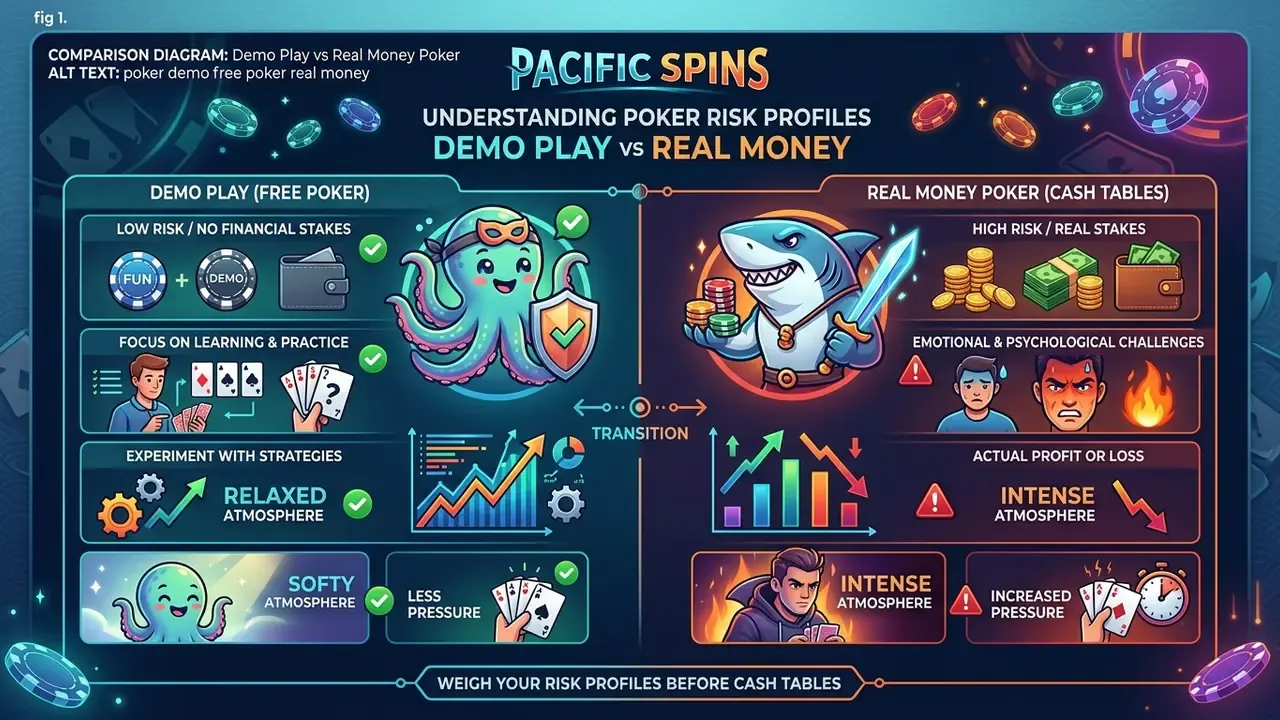
Free play simulates the technical sequence of dealing and betting well enough. Once real money enters, though, the differences are substantial:
- Tactical environment:In demo poker, players routinely make irrational calls, including all-ins with High Card hands, because losing play chips costs nothing. Note on evidence: reviews of simulated-gambling research conclude that free-play modes resemble gambling structurally, and at least one experimental study found that inflated free-play returns increased later real-money betting. The specific behavioural pattern described here, however, comes from operator hand-history observation rather than a single controlled trial, and further published data would strengthen it.
- Strategic transfer:Training in free poker builds fluency with software controls, blind timers and hand evaluation. It does not replicate the psychological pressure of risk management, bluffing, or fold equity in money poker.
- Cash-out realities:Play-money balances can never convert into withdrawable currency. Real money poker requires verified identity checks, bankroll discipline, and compliance with provincial payout rules.
Responsible gaming and financial risk alert
Real money poker involves genuine financial risk. Winning is never guaranteed, and balances are subject to mathematical variance and downswings.
- Age verification: In Canada, real money gambling is restricted to legal adults, 19+ in most provinces and 18+ in Alberta, Manitoba and Quebec. Age and identity verification (KYC) is mandatory before deposits or access to cash tables.
- Bankroll limits: Set deposit and loss limits before you play. Never gamble with money reserved for rent, utilities or groceries.
- Local legal compliance: Confirm your chosen platform operates legally in your jurisdiction, for example under iGaming Ontario and the AGCO or your applicable provincial regulator.
How common is online-only play? Prevalence data suggests digital play sits alongside land-based gambling rather than replacing it:
“Roughly 15% of gamblers reported using online modes exclusively, while more than 36% mixed online and offline formats.” , New Jersey Gambling Prevalence Survey of 3,512 residents (2023). https://www.njgamblinghelp.org/research

How to Choose a Poker Site and Evaluate Offer Value
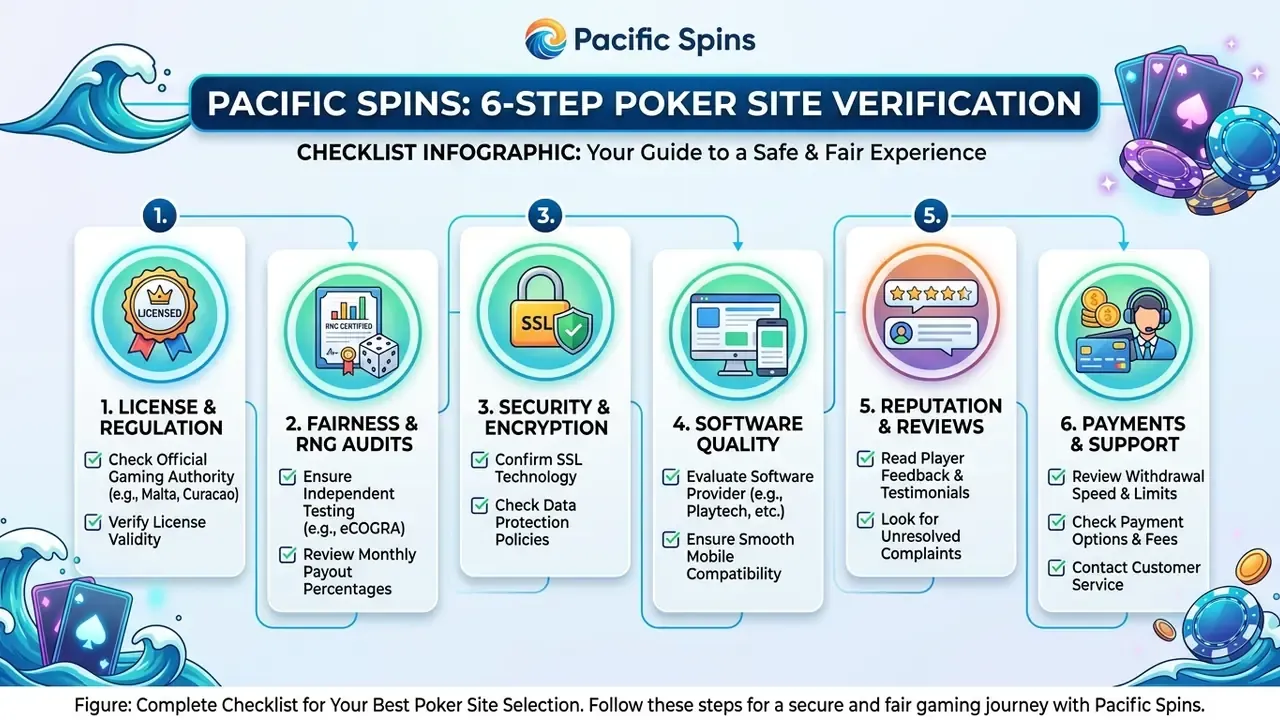
Selecting the best poker site means auditing four things: regulatory credentials, software security, liquidity pools, and payment flexibility. A reliable operator shows its licence details openly, submits its software to external RNG testing, and states withdrawal terms for Canadian players in plain language.
When you audit digital casino operator workflows, site security checks reduce to a short list: active TLS/SSL encryption, published RNG certificates, and clear separation of operational funds from player balances. On the payout side, rooms supporting direct Interac e-Transfers and localized CAD balances consistently turn cashouts around faster for Canadian residents than operators relying only on international wire transfers.
Legal Status: Ontario vs the Rest of Canada
Canada has no single national online poker market. Two structurally different environments coexist, and the difference directly affects the size of the player pool you will face:
| Market | Regulator / Licence | Player Pool | What It Means in Practice |
|---|---|---|---|
| Ontario (regulated commercial market) | iGaming Ontario (iGO) under the AGCO | Segregated Ontario-only pool, with limited international liquidity-sharing pilots | Provincially registered operators, mandatory responsible-gambling tools, CAD balances, local dispute resolution. Smaller fields and fewer massive MTT guarantees. |
| Rest of Canada | Kahnawake Gaming Commission, Malta Gaming Authority, Curaçao and similar offshore regimes | International shared liquidity | Larger fields, bigger guarantees, wider variant selection (PLO5, PLO6, Short Deck, Pineapple), but consumer protection depends on the offshore regulator’s standards. |
| Provincial Crown platforms | Provincial lottery corporations (BC, Quebec, Atlantic provinces) | Provincial or inter-provincial pools | Government-run, conservative game selection, direct banking integration. |
Practical takeaway: an Ontario resident should confirm the operator appears on the iGaming Ontario registered-operator list. Players elsewhere should verify the offshore licence number, the testing-lab certificate, and the published complaints procedure. Readers who want more background on iGaming Ontario and provincial regulation can review our dedicated iGaming coverage.
Interactive Checklist: 6-Point Poker Site Audit
Before you register or send a first CAD deposit, verify these six operational benchmarks:
- Provincial licensing and regulation: Is the site licensed by a recognized authority, such as iGaming Ontario and the AGCO, the Kahnawake Gaming Commission, or the MGA? Record the licence number and confirm it on the regulator’s own register.
- Independent RNG certification: Does the site display valid certificates from independent auditors (iTech Labs, GLI, eCOGRA) confirming fair shuffling? Regulators require RNG output to be uniformly distributed, unpredictable and non-repeating, with independent test evidence on file.
- Data encryption and security: Is the client protected by 256-bit SSL/TLS encryption covering personal, financial and gameplay data?
- Transparent bonus terms: Are wagering requirements, rake-release rates, eligible games and expiry dates spelled out in plain English?
- Payment processing and CAD support: Does the cashier support fast Canadian deposits and withdrawals (Interac, e-wallets, cards) without forced currency conversion fees? Check whether payouts must return to the deposit method.
- Responsible gambling controls: Are deposit limits, session timers, cooling-off periods and self-exclusion tools reachable directly from the account dashboard? Regulated operators must let you withdraw your own deposited funds even while a bonus is active.
Security, Reputation, and Poker Software
The integrity of a poker site rests on its backend infrastructure. Regulated operators run strict protocols to protect game integrity and shut down unfair practices:
- Anti-bot protocols:Monitoring systems track network latency, mouse movement vectors and bulk-action decision speeds to flag automated software.
- Anti-collusion controls:Security algorithms scan hand histories for suspicious patterns, such as two players soft-playing each other or sharing hole-card information. Academic work on collusion detection notes that purely automated screening can miss coordinated humans entirely, which is why unusual patterns get escalated to manual investigation.
- Real-time assistance (RTA) bans:Top-tier platforms prohibit external GTO solvers, auto-action scripts and live advice software running alongside the poker client.
Reputable operators publish enforcement records showing account suspensions and confiscated funds returned to affected players. That is a meaningful trust signal. Where a room has a documented bot problem, check whether affected players were reimbursed historically, because the remediation record matters as much as the detection claim.
Welcome Bonus, Bonus Terms, and Reward Conditions
Promotional incentives are marketing tools, and their real financial value sits entirely in the terms.
“About 61% of surveyed players reported that bonus offers influence their betting decisions; the share is higher among at-risk players.” , Playtech, “An overview of responsible gambling research on bonus offers” (2023). https://www.playtech.com/responsible-gambling/research
- Welcome bonus (deposit match):Usually marketed as “100% match up to $600 CAD.” Unlike casino bonuses granted immediately with high wagering multipliers, poker bonuses release incrementally. A typical structure pays out $5 CAD for every $25 CAD you generate in tournament fees or cash game rake.
- Rakeback:The platform refunds a percentage of the rake or fees you generate straight into your withdrawable balance, commonly 10% to 40%, and up to 65% inside aggressive VIP schemes. Rakeback is one of the most transparent reward structures, because it carries no wagering multiplier.
- Tournament tickets and freerolls:Welcome packages often include entry passes to real-money tournaments or exclusive freerolls, meaning zero entry fee with a real cash prize pool. Freeroll winnings may be immediately withdrawable or subject to a minimal 1x playthrough, depending on the room.
“76% of players who received a promotional offer used it, and free spins were redeemed roughly ten times more often than other offer types.” , UK Gambling Commission, “Exploring consumer journeys using gambling promotional offers and incentives” (2023). https://www.gamblingcommission.gov.uk/report/exploring-consumer-journeys-using-gambling-promotional-offers-and-incentives
When you review a bonus, check the wagering timeframe (typically 30 to 90 days to release the full amount) and confirm your real cash deposit stays withdrawable at all times without forfeiting earned cash rewards.
“In one study covered by the Playtech review, 58% of participants underestimated the wagering requirements attached to bonuses they had accepted.” , Playtech, “An overview of responsible gambling research on bonus offers” (2023). https://www.playtech.com/responsible-gambling/research
Attribution update: promotional-behaviour data in this section comes from the UK Gambling Commission’s 2023 consumer-journey research linked above, replacing the previously cited “Gambling Commission Promotional Guidelines 2026.”
Understanding Online Poker Rakeback Models
For long-term profitability, rakeback is the number that matters most. Operators use three main models:
| Rakeback Model | How It Works | Best For | Typical Effective % |
|---|---|---|---|
| Flat-rate rakeback | Fixed percentage refunded weekly or monthly regardless of volume, for example a flat 27% on several US-facing networks. | Casual and low-volume players | 20% to 30% |
| Tiered VIP / progressive | Multi-level loyalty systems where higher volume unlocks steeply higher cashback rates. | High-volume players and grinders | 10% to 65%+ |
| Randomized / gamified | Cashback awarded through mystery wheels, chest openings, leaderboards or splash pots at the tables. | Recreational players | 15% to 40%, high variance |
How to Calculate the Real Value of a Poker Bonus
Turn every headline offer into an effective rakeback percentage before you judge it:
Effective rakeback % = (bonus amount released ÷ rake paid to release it) × 100
- Example 1:A $100 CAD bonus that releases fully after $500 CAD in rake equals a 20% effective rakeback. Decent for a casual player, weak for a grinder.
- Example 2:A “$2,000 CAD, 100% match” bonus releasing at $5 per $25 of rake requires $10,000 CAD in rake to clear fully. Again a 20% effective rate, and at micro-stakes volumes that may take far longer than the 30 to 90 day expiry window allows.
- Rule of thumb:compare the bonus’s effective percentage against the room’s standing rakeback. If standing rakeback is 30% with no expiry, a one-time 20% bonus with a 60-day clock is the weaker deal.
Canadian Payments: Deposit and Withdrawal Timelines in CAD
For Canadian players, withdrawal speed is often the deciding factor. Approximate processing windows at established rooms look like this. Always confirm current terms in the cashier, since internal review and KYC checks can stretch any timeline.
| Method | Deposit Speed | Typical Withdrawal Time | Notes for Canadian Players |
|---|---|---|---|
| Interac e-Transfer / Interac Online | Instant to 1 hour | 1 to 24 hours after approval | Native CAD, no currency conversion; the most common local rail for Ontario-registered and Canada-facing rooms. |
| E-wallets (MuchBetter, ecoPayz, Skrill, Neteller) | Instant | 0 to 12 hours, often same day | Fastest fiat option; some rooms exclude e-wallet deposits from bonus eligibility. |
| Credit / debit card (Visa, Mastercard) | Instant | 1 to 3 business days, sometimes up to 5 | Withdrawals usually must return to the same card; some Canadian issuers decline gambling deposits. |
| Bank wire / EFT | 1 to 3 business days | 3 to 7 business days | Higher limits, higher fees; suited to large infrequent cashouts. |
| Cryptocurrency (BTC, ETH, USDT) | 10 to 60 minutes | Under 1 hour to a few hours; some rooms process payouts every 2 hours | No conversion at the cashier, but exposure to crypto price volatility; dominant option at offshore rooms. |
| Prepaid vouchers (Paysafecard and similar) | Instant | Not supported for withdrawals | Deposit-only; you must nominate an alternative payout method. |
Two practical warnings. First, check whether your balance is held in CAD or USD, because a USD balance adds a 2% to 4% conversion spread on both ends. Second, complete KYC before you request your first payout: document review, not the payment rail, causes most delays.
How to Start Playing Poker Online After Choosing a Site
Your first session follows a short, structured onboarding path:
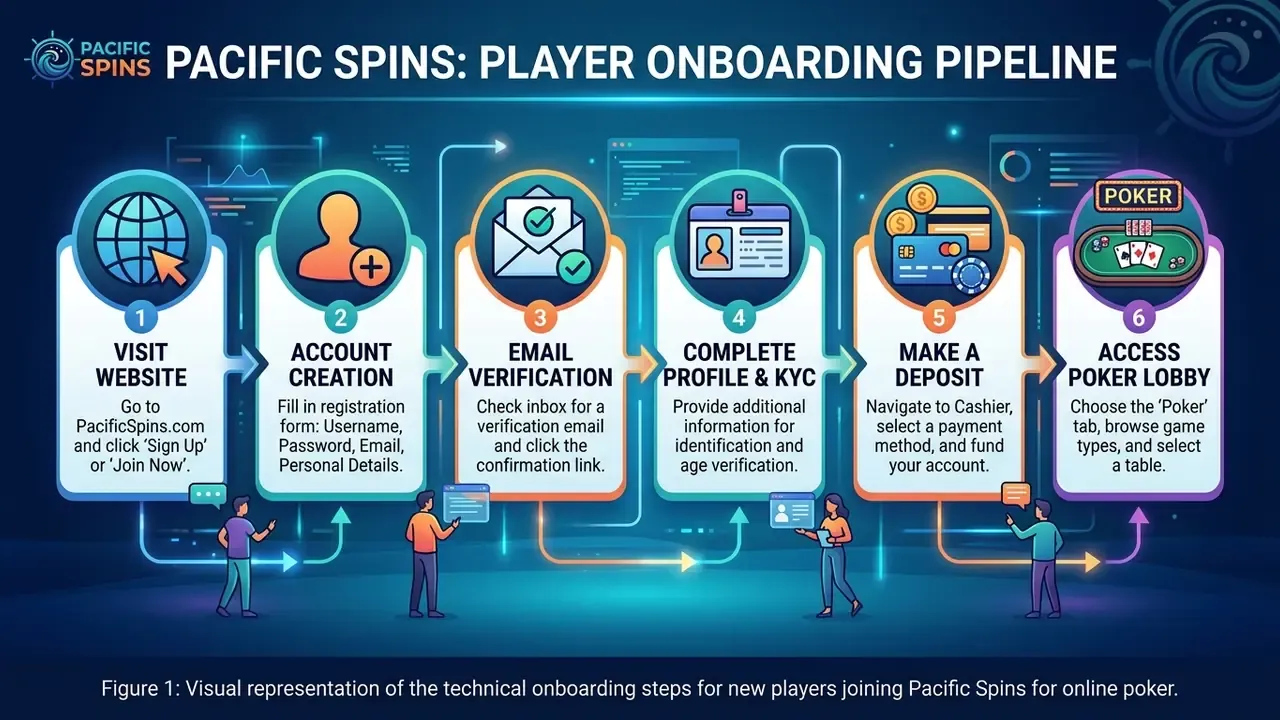
- Account registration: Visit the verified operator page and complete the sign-up form with accurate details: full legal name, date of birth, residential address, email.
- Identity verification (KYC): Under regulatory mandates, operators must obtain and verify customer identity before the customer is permitted to gamble. Upload a government-issued photo ID (driver’s licence or passport) plus a recent utility bill or bank statement showing your address. Some rooms also require a selfie check inside the account or profile menu.
- Software installation: Download the official poker client for Windows or Mac, install the mobile app for iOS or Android, or use browser-based instant play where supported.
- Set responsible gaming limits: Open your profile menu and set daily, weekly or monthly deposit limits before you visit the cashier. Do this step first, not later.
- Fund your account (CAD): Choose your preferred deposit method, Interac e-Transfer for most Canadians, and transfer your starting funds.
- Lobby navigation and table selection: Open the poker client lobby. Filter by game type (Hold’em, PLO), stakes (micro, low, medium) and format (demo, cash game, tournament), then take an open seat.
FAQ: Taxes, Interac, Bots and Player Pools
For recreational players, gambling winnings in Canada are generally treated as windfalls and are not taxed. Players whose poker activity resembles a business, meaning systematic professional-scale play with an expectation of profit, may be assessed differently, and interest earned on winnings is taxable. This is general information, not tax advice. Consult a qualified Canadian tax professional about your situation.
Moving funds to a licensed operator through Interac is routine banking activity for Canadian players. The critical question is the operator’s licensing status in your province: in Ontario, use platforms registered with iGaming Ontario and the AGCO; elsewhere, verify the offshore licence and the payout terms. Some card issuers block gambling merchant codes, which is one reason Interac and e-wallets dominate Canadian cashiers.
Regulated and reputable rooms ban bots, auto-action scripts and real-time assistance software, and they run detection built on latency profiling, timing-pattern analysis and hand-history review. Warning signs at the tables: perfectly uniform action timing, robotic bet-size distributions, and identical strategies across several accounts. Report suspicions through the room’s security channel with hand IDs. Well-run operators publish enforcement statistics and reimburse affected players.
Ontario’s regulated market historically uses segregated player pools, so liquidity comes from Ontario players only. Smaller fields, smaller guarantees, and often softer competition, plus stronger local consumer protections. International pools deliver bigger prize pools and more variants, at the cost of offshore-only dispute resolution.
Use demo mode to learn the client, the timers and the hand rankings, usually a few sessions. Move to the smallest real-money stake once the interface feels automatic, because play-money opponents call all-in with High Card hands and teach the wrong lessons about fold equity. Set deposit limits before that transition.
Five Mistakes New Players Make in Their First Month
Patterns repeat in support tickets and forum posts. These five cost Canadian players the most:
- Depositing before completing KYC. Verification catches up with you at the cashout, not the deposit. Upload documents on day one.
- Chasing a bonus at the wrong stakes. A rake target designed for $0.50/$1 will not clear at $0.02/$0.05 inside a 60-day window. Calculate first.
- Playing tournaments on a cash-game bankroll. Twenty buy-ins in MTTs is not a bankroll, it is a coin flip with extra steps.
- Confusing house-banked poker with PvP poker. Sitting at Three Card Poker expecting to outplay opponents makes no sense, because there are no opponents.
- Skipping the deposit limit. It takes thirty seconds to set and removes the worst decision you might make at 2 a.m.

Conclusion and Summary
Online poker blends mathematical probability, strategic discipline and psychological execution across a wide range of digital formats. Whether you are memorizing hand hierarchies in free-play software or managing a real money CAD bankroll across cash games and tournaments, the same two requirements hold: choose licensed, audited platforms, and keep strict bankroll controls.
Before you deposit, compare operator credentials, read the bonus conditions in plain English, convert every promotion into an effective rakeback percentage, confirm your CAD withdrawal timeline, and set deposit limits. Compare on the facts, read the terms before you deposit, and play responsibly: 19+, or 18+ in Alberta, Manitoba and Quebec.
Appendix A: Source Notes and Revisions
For transparency, the following attributions from earlier versions of this guide have been updated in the main text:
- Previous wording:“Empirical studies tracking millions of online poker hands confirm that variance causes short-term performance to swing wildly around a player's true skill level (University of Alberta Computer Poker Research Group).” Retained here for reference; superseded in the main text by the peer-reviewed study of 91,439 players and 85M+ hands (https://doi.org/10.1371/journal.pone.0291429), which supplies sample size, methodology and a DOI.
- Previous wording:“…depending on individual room terms (Gambling Commission Promotional Guidelines 2026).” Retained here for reference; superseded in the main text by the UK Gambling Commission’s 2023 consumer-journey research on promotional offers and incentives.
- Previous wording:“Empirical session data shows skilled cash game players experience losing sessions roughly 43% of the time, with downswings remaining manageable under steady play (Betting Strategy Dataset).” Retained here for reference; superseded in the main text by the fuller 847-session citation including average loss size and stake level.
General disclaimer: This article is informational and does not constitute legal, tax or financial advice. Gambling regulations differ by province and change over time, so verify current rules with your provincial regulator. Real money play involves risk of loss. If gambling is causing you harm, contact your provincial problem gambling helpline or a licensed counsellor.