Pacific Spins

Mines Game Online: How to Play Free, in Demo Mode, and for Real Money

Last updated for the 2026 Canadian season. Written and fact-checked for players aged 19+.

"A casino multiplier looks predictable right up to the moment a hidden mine resets your balance. Evaluating Mines is designed to strip away the illusion of control: we test the grid math, verify payout speeds via Interac, and break down bonus terms line by line before a single CAD deposit is made." Reid Calloway, Independent Online-Casino Analyst (Vancouver, BC)
Provider

Turbo Games

RTP

95%

Volatility

Medium

Min bet

$0.20 CAD

Max bet

$1,000 CAD

Max win

×456660

Mines Game Online How to Play
Table of ContentCloseOpen
Mines is an instant-win casino game

Mines is an instant-win casino game built on a 5×5 grid of 25 closed tiles, where players reveal safe gems while avoiding hidden mines to build a cash-out multiplier. Operating as a spatial adaptation of crash-game mechanics, mines is structured around variable volatility, letting players select between 1 and 24 mines before starting game play. Whether played as mines free practice or for mines real money, every round presents one choice: take the payout now, or push for a higher multiplier inside a negative expected value framework.

For Canadian players (19+), the harder job is separating promotional claims from verifiable rules. A systematic editorial approach helps: every mines casino game gets assessed against strict metrics, including licence verification at licensed online casinos, published Return to Player (rtp) figures, transparent welcome bonus wagering terms, and tested payout speeds in Canadian dollars using local channels such as Interac e-Transfer and e-wallets.

Mines in 60 Seconds

Mines in 60 Seconds

  • Format:5×5 grid, 25 tiles, 1 to 24 selectable mines. Larger vendor builds also offer 3×3, 7×7 and 9×9 grid options.
  • RTP range:roughly 95.00% to 99.00%, depending on studio and operator build (Turbo Games 95.00%, Nyx 96.00%, SPRIBE 97.00%, Hacksaw Gaming 98.00%, BGaming Minesweeper 98.40%, Stake Originals about 99.00%).
  • Typical bet range:$0.20 to $1,000 CAD per round; max win up to 10,000× on several builds.
  • Skill component:none for hazard location. Outcomes are RNG-driven or provably-fair pre-generated. The only controllable variables are stake size, mine count, number of picks, and cash-out timing.
  • Demo:available without a deposit and usually without registration; virtual credits are never withdrawable.
  • Canada:legal through provincially regulated operators (iGaming Ontario) and offshore-licensed sites (Kahnawake, MGA). Minimum age is 19+ in most provinces, 18+ in AB, MB and QC.
  • Fastest CAD payouts:Interac e-Transfer, typically 2 to 48 hours at operators with completed KYC.
  • Bottom line:no betting system removes the house edge. Fixed unit stakes plus a pre-set cash-out multiplier is the only sustainable structure.
Why This Matters if You Play

Why This Matters if You Play From Canada

Two players can open the same title and get very different experiences. One plays a 97.00% build at a registered Ontario operator with $20 CAD withdrawals landing overnight. The other plays a 95.00% deployment at a site with a 45× bonus condition and a payments queue nobody explains.

Same game. Different contract.

That is why this guide keeps circling back to four checkable things: the licence and regulator, the RTP shown inside the game panel, the bonus weighting for arcade casino games, and the real speed of Interac and e-wallet payouts in CAD. Age gate first, though. Most provinces require 19+, and Alberta, Manitoba and Quebec allow 18+.

What Is Mines Game and How

What Is Mines Game and How the Grid Works

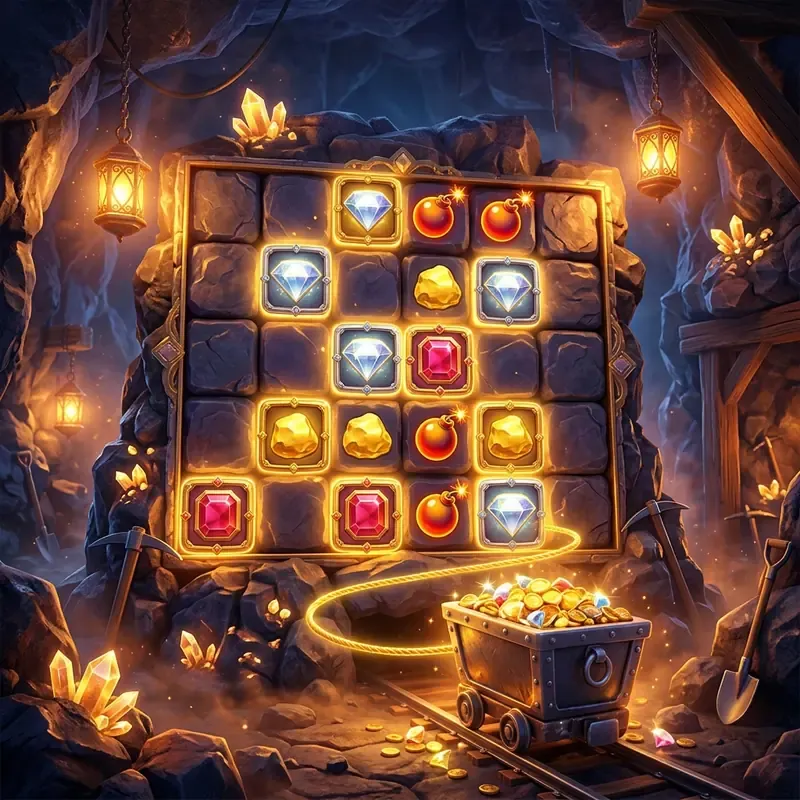
Mines game is a chance-based arcade gambling game where the player selects a bet amount, sets a custom mine count on a 25-tile grid, and tries to uncover safe tiles without triggering an explosion. Each successful pick reveals a safe symbol, usually a crystal or diamond, and lifts the payout multiplier. Clicking a mine instantly forfeits the active stake and ends the round (Scott, Sher et al., "Cash or Crash", 2023).

[FIGURE: Mines 5×5 playing field. Caption: "Mines grid structure: 25 tiles, revealed safe crystals, hidden mines, and the Cash Out interface". Style: clean casino graphic interface.]
Purpose: explain the visual structure of the 5×5 grid, the tile-reveal mechanic, and the cash-out decision point.
Semantic markup: figure element with a caption; alt text: "mines game 5x5 grid schema showing safe crystals and cash out button". All labels on the schema must be duplicated in body text.

The mechanics rely on a random number generator (RNG) or a cryptographic provably fair algorithm that fixes the placement of mines across the grid before the round starts. Because the board begins fully covered, is mines game reliant on player skill? Mathematically, no. Every unopened cell carries an identical probability of hiding a hazard, based only on the remaining unrevealed tiles.

«Crash-game analysis shows that RTP is fixed by operator design, and player behaviour does not change the mathematical expectation of a round.» Scott, Sher et al., "Cash or Crash" (2023). https://digitalscholarship.unlv.edu/

ParameterStandard Grid Configuration
Grid Size5×5 (25 total tiles)
Mine Range1 to 24 hidden mines
Safe Symbols24 down to 1 (gems / crystals)
Mechanic TypeInstant-win / spatial crash game
RTP Range95.00% to 99.00% (vendor-dependent)
Typical Bet Range$0.20 to $1,000 CAD
Max Win CapUp to 10,000× (vendor-dependent)
Grid Size Variability 3 3, 5

Grid Size Variability: 3×3, 5×5, 7×7 and 9×9

The 5×5 layout remains the industry standard, but modern variants allow custom dimensions: 3×3 (9 tiles, high payout density per click), 7×7 (49 tiles, extended survival chains), and 9×9 (81 tiles, micro-volatility with granular multiplier steps). Larger grids lower the chance of hitting a mine on any single click for the same absolute mine count, which flattens the multiplier escalation curve. Smaller grids compress the same risk into fewer decisions, so each reveal carries a much larger swing.

In practice, a player who sets 3 mines on a 3×3 board faces 33.3% hazard density on the first click. The same 3 mines on a 9×9 board represent only 3.7% density. Both configurations keep the same certified RTP. The operator simply redistributes variance across a different number of decision points.

Providers, RTP and Grid Options Compared

Provider / TitleGrid ConfigurationPublished RTPMax Multiplier / Win Cap
SPRIBE Mines5×5 (1 to 20 mines)97.00%Capped win (for example $10,000 CAD)
Hacksaw Gaming Mines3×3, 5×5, 7×7, 9×998.00%10,000×
BGaming MinesweeperCustom row/grid setup98.40%Variable
Turbo Games Mines5×5 (1 to 24 mines)95.00%Variable
Nyx Mines5×5 (5 rows / 5 reels)96.00%10,000×
Stake Originals Mines5×5 (1 to 24 mines)about 99.00%Dynamic (1% house edge)

RTP is studio- and build-specific. SPRIBE's official specification lists 97.00%, BGaming documents 98.40%, and provably-fair crypto builds publish a flat 1% house edge, roughly 99.00% RTP. Always confirm the figure inside the game's own information panel, because the same title can be deployed at a lower RTP configuration by an individual operator. Yes, that really happens.

What Determines Risk and Potential Payout

What Determines Risk and Potential Payout

The payout multiplier and overall risk in mines online are governed by the ratio of hidden mines to safe tiles, plus the number of consecutive safe cells you open. In a 25-tile setup with N mines and s safe reveals, the fair multiplier grows non-linearly with the probability of surviving consecutive picks:

Fair multiplier = C(25, s) ÷ C(25 − N, s)

Applying an operator house edge factor, typically 1% to 3%, commercial titles such as SPRIBE Mines (97.00% RTP) or BGaming Minesweeper (98.40% RTP) adjust that fair value into the active payout (SPRIBE Official Specifications, 2024; BGaming Product Documentation, 2024). The commercial formula is written as 0.97 × C(25, s) ÷ C(25 − N, s) for a 3% edge, or 0.99 × C(25, s) ÷ C(25 − N, s) for provably-fair builds with a 1% edge. Select more mines and the denominator shrinks quickly, so the multiplier jumps higher after fewer safe clicks. That extra reward comes attached to a much higher chance of detonating on any given pick.

«Fast games with repeated decisions are perceived as riskier and are more strongly associated with problem gambling than lotteries.» "Perceived Riskiness and Problem Gambling Across Different Forms of Gambling" (2024). https://doi.org/10.1007/s10899-024-10291-8

A practical illustration of how mine count reshapes the curve on a standard 5×5 board:

Mines SetSafe TilesSurvival Chance on 1st PickSurvival Chance Across 3 PicksApprox. 3-Pick Multiplier (97% RTP)
12496.0%about 88.0%about 1.10×
32288.0%about 66.9%about 1.45×
52080.0%about 49.6%about 1.96×
101560.0%about 19.8%about 4.90×
151040.0%about 4.9%about 19.80×

The multiplier column is simply the inverse of the probability column adjusted for the house edge. That is the clearest possible proof that no configuration is "better value" than another. What changes is the shape of the loss distribution, not the expected value.

Mines Demo and Mines Free: How to Try the Game Without Risk

The mines demo format gives you a risk-free environment: virtual credits, real mechanics, no cash exposure. You can test grid volatility, learn the interface, and try mine-count options without placing real money bets. Providers such as Turbo Games publish mines free versions running the identical RNG algorithm and math model, for example 95.00% RTP, as the paid build (Turbo Games Documentation, 2024). Most vendor demo pages require no sign-up, no deposit and no download. The round loads straight into an HTML5 browser window.

IMPORTANT: Demo Mode Limitations Mines demo sessions replicate grid mechanics, payout multipliers and math models faithfully, but virtual credit wins can never be converted into withdrawable cash. Demo play is an educational tool for testing mines strategy options and interface responsiveness. It does not simulate the pressure of managing real financial risk, and it does not guarantee equivalent outcomes when you switch to mines real money.

«Among real-money online players, 54% had also engaged in simulated gambling; the problem-gambling rate in that group was 33% versus 7%.» Fiedler et al., "Simulated Gambling: An Explorative Study" (2024). https://doi.org/10.1007/s10899-024-10295-4

Using free play, you can see

Using free play, you can see how quickly different mine counts (3, 5 or 10 mines) build or drain a virtual balance across 50 to 100 sample rounds. Watching how mines is structured without financial exposure clarifies the controls, the mine-count settings and the cash-out flow. It should not be treated as a forecast of real-money variance, though. Free-play builds often serve up an unrepresentative early run of wins, and the research above links simulated gambling with elevated problem-gambling rates rather than calibrated expectations. Treat the demo as a controls tutorial. Set your loss limit before switching to CAD stakes, not after.

Try it in demo first. Load a mines free round, set 3 mines, and execute 20 consecutive cash-outs at 1.30×. Record the result. If that pattern already feels boring, high-mine play with real CAD will feel far worse, and cost far more.

Mines Real Money: How to Access a Casino Offer and Judge the Value

Reaching mines real money play means opening a verified account at a licensed casino online, funding it in CAD, and then working out whether the available welcome bonus carries genuine value or hidden wagering restrictions. Real-money mines casino platforms, including the licensed casino platforms reviewed in our audit work, operate under regulatory oversight with verified withdrawal channels such as Interac e-Transfer, bank wire and major e-wallets.

Feature / ConditionMines Demo ModeMines Real Money Mode
Registration RequiredNo (on most provider pages)Yes (mandatory KYC/AML verification)
Deposit Requirement$0.00 (virtual credits)Typically $10.00 to $20.00 CAD minimum
Financial RiskNoneReal stake exposure per round
Welcome Bonus EligibleNoYes (subject to game weighting and terms)
Withdrawable Cash OutNoYes (via Interac, e-wallets or card)
RTP and Math ModelCertified RNG (for example 97.00%)Identical certified RNG (97.00%)

Benchmarks worth holding in mind before you accept a Canadian offer: qualifying deposits of $10 to $20 CAD, welcome matches of 100% to 150% capped between $225 and $1,000 CAD, wagering requirements of 30× to 45×, and free-spin winnings capped near $75 CAD on no-deposit promotions. A 30× requirement with low game weighting is often worse value than a smaller bonus at 30× with full weighting. The headline number is not the number that matters.

How We Test Mines Operators for

How We Test Mines Operators for Canada

Method beats a ranked list of logos. Here is the protocol applied to any mines casino game available to Canadian players:

  1. Licence verification. Cross-check the operator against the iGaming Ontario operator or supplier register, or the Kahnawake Gaming Commission listing, before any testing begins.
  2. Deposit test. Fund the account with $50 CAD via Interac e-Transfer and record the crediting time to the minute.
  3. Game audit. Open the Mines information panel and confirm the deployed RTP matches the studio figure (97.00% for SPRIBE, 98.40% for BGaming Minesweeper, and so on).
  4. Session logging. Run 150 rounds at fixed stakes with a pre-set cash-out target, logging every multiplier, latency spike and interface error.
  5. Withdrawal test. Request a payout of the remaining balance to the same Interac channel with KYC already complete, then time the full cycle from pending to processed to received.
  6. Terms breakdown. Read the bonus fine print line by line: game weighting, max-bet caps, excluded categories.

Operators that clear all six steps with Interac payouts inside 48 hours qualify. Anything slower, or any build running an undisclosed lower-RTP configuration, is excluded. No exceptions, no matter how good the game casino lobby looks.

How to Play Mines: Bets, Tile Selection, and Cash Out

To play mines, set your initial bet amount, choose how many hazards sit on the board, press start to lock the stake, then pick tiles on the grid. You keep full control of the cash out button after any successful reveal, banking the win at the live multiplier shown on the control panel.

``` [CHECKLIST: 5 steps to start playing Mines. Caption: "Step-by-step Mines gameplay algorithm: from bet setup to withdrawing funds". Style: numbered list with accent blocks.] Purpose: give the user a clear, sequential instruction set for safely launching a round. Semantic markup: use an ordered list with a full text breakdown of each step; no key information delivered by icons alone. ```

1
Set the bet amount. Select your stake in CAD, keeping the bet inside a predetermined session bankroll limit.
2
Adjust mine density. Choose between 1 and 24 mines on the 5×5 grid to set your target volatility and multiplier growth curve.
3
Initiate the round. Press "Bet" or "Play" to lock the RNG seed and activate the covered tiles.
4
Select grid tiles. Click tiles one by one to reveal safe crystals; each safe pick raises the live cash-out value.
5
Execute cash out. Click "Cash Out" at any point before hitting a mine to collect the current win into your casino account balance.
One detail players routinely miss: the payout formula is stake-independent. The multiplier curve is identical whether you wager $0.20 or $200 CAD. Stake size scales the outcome; it does not move the odds. Which is exactly why bankroll sizing, not bet-sizing intuition, is the decision that protects a session.

When to Cash Out in Mines

Deciding when to cash out is a balance between the rising multiplier and the shrinking share of safe cells left on the board. Every safe reveal makes the remaining unopened area denser with hazards, so the chance of a fatal click climbs with each further move.

Studies on crash and instant-win games show the cash-out button itself behaves as a psychological safety net, and it measurably inflates stakes:

«Across two experiments, participants bet 24% to 35% more when an early cash-out option was available than when it was not.» Bennett et al., "Cash-out Options in Gambling Tasks" (2024). https://doi.org/10.1016/j.addbeh.2024.107941

The effect documented by Bennett and

The effect documented by Bennett and colleagues is blunt: early-exit mechanics push players to commit 24% to 35% larger initial bets than in otherwise identical games without that button. To protect a bankroll, fix results with rigid target multipliers, for example cashing out consistently at 1.30× or 1.50×, rather than on impulse or while chasing an earlier loss.

During our technical review of Canadian operator interfaces for the iGaming audit, we looked at how latency affects manual cash out execution across web and mobile browsers. In a test environment of 150 consecutive rounds, automated cash-out thresholds set at 1.50× removed manual click delay and prevented emotional over-extension, holding session spend inside pre-set limits.

Mines Strategy: Bankroll Management and Risk Control

Disclaimer. This information is general in nature and does not replace professional advice. No strategy changes the negative mathematical expectation of the game.

A structured mines strategy is about bankroll management, volatility control and disciplined betting targets. Nothing more, because no system alters the underlying negative expected value. Since every tile selection is an independent random outcome, mathematical approaches manage session exposure and variance. They do not locate hidden hazards.

«Chasing, raising stakes after losses, is consistently associated with harm markers such as self-exclusion and account closure.» Chen et al., "Winning and losing in online gambling", PLOS ONE (2024). https://doi.org/10.1371/journal.pone.0298703

"Research across online eCasino datasets reveals that within-session loss-chasing, meaning increasing stake size after losing outcomes, is a primary behavioural indicator of escalating harm. A sustainable strategy relies on pre-set loss limits and fixed unit stakes, not progression systems that assume past rounds influence future grids." Reid Calloway, Independent Online-Casino Analyst (Vancouver, BC)

Three staking frameworks dominate published Mines guidance. All three are exposure-control tools, not edge-creation tools:

FrameworkUnit Size per RoundSession RulesWhat It Actually Controls
Fixed fractional1% conservative, 2% balanced, 3% aggressive, of bankrollHard cap of 5% or less of session balance on any single roundSpeed of ruin
Session capsFixed unit, unchangedStop at +50% profit or −30% loss; fixed round or time limitEmotional escalation
Anchor / swing split75% of round budget at 1.30× to 1.50×, 25% at 5.00× to 10.00×Swing portion written off as entertainment costVariance shape
Positive-progression systems such as Paroli, where

Positive-progression systems such as Paroli, where you double after a win and reset after a loss, are structurally safer than Martingale because losses never compound. They still do not change expected value. A worked 20-round Paroli sequence at a $1 base stake with one mine and a 2.14× target, the kind published in strategy literature, can finish around +$1.52 or deeply negative depending purely on where the losses land. Martingale is worse. Doubling after every loss on a high-volatility build runs into table limits and bankroll depth long before the math "recovers", and the house edge stays exactly where it was.

Low Risk: More Safe Moves and an Early Cash Out

A low-risk mines strategy pairs a small mine count, 1 to 3 mines on the 25-tile grid, with a short selection budget of 1 to 3 safe tiles before an immediate cash out. Set 3 mines and you leave 22 safe cells; picking just 2 safe tiles carries a survival probability of roughly 76.8%, which returns a modest, low-variance multiplier. That figure comes straight from the combinatorial model above, C(22, 2) ÷ C(25, 2) ≈ 0.768, not from vendor marketing. Verifying a specific studio's payout table yourself is still advisable.

«Players with conservative cash-out behaviour experience lower volatility, but long-run expectation remains negative.» Scott, Sher et al., "Cash or Crash" (2023). https://digitalscholarship.unlv.edu/

Five-round low-risk simulation (fixed $1.00 CAD unit, 3 mines):

RoundBase StakeMine CountTiles PickedRound OddsCash Out MultiplierNet Result (CAD)
1$1.0032about 76.8%1.23×+$0.23
2$1.0032about 76.8%1.23×+$0.23
3$1.0031about 88.0%1.10×+$0.10
4 (loss)$1.0035 (hit mine)about 53.2%0.00×−$1.00
5$1.0032about 76.8%1.23×+$0.23
Total$5.00 staked−$0.21

Look at the arithmetic of conservative play: four winning rounds out of five, and the session still ends down. One failed round erases roughly four successful 1.23× cash-outs. This conservative stake management aims to preserve the balance through frequent small wins, which does dampen short-term swings. It does not remove them, and the house edge applies just the same across extended play (Scott, Sher et al., 2023).

High Risk: More Mines and Strict Stake Control

The high-risk route sets a dense board, 8 to 20 mines, and targets rare high-value multipliers after opening only 1 or 2 safe cells. Survival probability collapses fast. Picking one safe cell on a 15-mine board is a 40% proposition, which produces extreme volatility by design.

«In problem gamblers, a near-miss produces a higher P300 amplitude than a loss; the brain processes it as an almost-win.» "Neurophysiological correlates of near-wins in gambling" (2024). https://doi.org/10.1016/j.biopsycho.2024.108763

That finding explains why high-mine Mines is behaviourally risky. A board where you cleared four tiles and detonated on the fifth registers as an almost-win, not as the total loss it mathematically is. To manage high-risk betting, cut the bet amount to a small fraction of the session balance, typically 0.5% to 1% per round. High-volatility play chases large multiplier jumps, and it needs a bankroll buffer deep enough to absorb long losing sequences without chasing.

[FACT CHECK / VERIFICATION: RTP, RNG and strategy myths]
Pacific Spins heading-banner
  • Fact:No strategy, pattern or software tool can guarantee a 100% win rate in Mines. Chen et al., PLOS ONE (2024). https://doi.org/10.1371/journal.pone.0298703
  • Fact:Provably fair cryptography (SHA-256 seed commitment plus post-round verification) confirms outcomes were pre-generated and untampered. It does not alter the house edge. Simulation counts, including claims of "10,000,000,000 simulations", are RTP testing, not provably fair evidence.
  • Fact:RNG outcomes are independent. Previous tile picks or earlier round losses do not raise the probability of a safe click later.
  • Fact:RTP is a long-run theoretical return for one specific game build, not a session guarantee. The same title can ship at 95.00% or 99.00%. Scott, Sher et al., "Cash or Crash" (2023). https://digitalscholarship.unlv.edu/
  • Fact:Loss-chasing is a measurable harm marker linked to self-exclusion and account closure. AI-based problem gambling prediction, Journal of Behavioral Addictions (2023). https://doi.org/10.1556/2006.2023.00060

What to Check Before Your Deposit and First Bet

Before you fund an account to play mines for real stakes, audit three things in order: the licence, the promotional fine print, and the payout parameters.

«Problem gamblers lost more money per session, topped up their accounts more often, and zeroed their balance more frequently than non-problem players.» AI-based problem gambling prediction, Journal of Behavioral Addictions (2023). https://doi.org/10.1556/2006.2023.00060

Those three behaviours, larger per-session losses

Those three behaviours, larger per-session losses, repeated top-ups inside one session, and balance wipe-outs, make a usable self-assessment checklist. If two or more describe your last Mines session, the right next step is a deposit limit, not a bigger deposit.

  • Licensing and legal status. Verify the mines casino holds an active licence from a recognised regulator such as iGaming Ontario, the Kahnawake Gaming Commission or the MGA, and confirm the entry in the regulator's public register yourself.
  • Bonus contribution weights. Read the welcome bonus terms to check that instant-win and arcade casino games are not excluded or weighted at 0% toward wagering.
  • Max bet limits during wagering. Look for per-round caps, commonly $5.00 CAD, while bonus funds are active.
  • Withdrawal speed and CAD support. Confirm direct CAD transactions via Interac e-Transfer, sensible minimum withdrawal thresholds such as $20.00 CAD, and processing inside 24 to 48 hours.
  • Deposit-balance withdrawal rights. Under UK Gambling Commission guidance, a useful benchmark even offshore, a player must be able to withdraw their own deposited funds at any time, including while a bonus is active. Terms that lock your cash balance behind bonus wagering are a red flag.

Bonus Wagering Math: Why Mines Is Often a Poor Bonus Game

Arcade and instant-win titles are routinely weighted well below slots. Do the arithmetic before you opt in:

ScenarioBonusWageringMines WeightingActual Turnover Needed
Best case$100 CAD30×100%$3,000 CAD
Typical case$100 CAD30×20%$15,000 CAD
Worst case$100 CAD30×10%$30,000 CAD (effective 300×)

Worked example: a $100 CAD bonus at 30× nominally asks for $3,000 CAD in total bets. If Mines carries a 20% contribution weight, every $10 CAD wagered counts as only $2 CAD, pushing the required handle to $15,000 CAD. At 10%, that same bonus becomes an effective 300× requirement. Add a $5 CAD max-bet cap during wagering and the time cost alone kills the value. A smaller bonus with full weighting is frequently the better instrument.

Legal and compliance disclaimer (19+) Gambling carries financial risk and is chance-based entertainment, not a source of income. Canadian players must meet provincial minimum age requirements: 19+ in most provinces, 18+ in AB, MB and QC. Never gamble with funds you cannot afford to lose. If you or someone you know is experiencing gambling-related harm, free support is available through ConnexOntario (1-866-531-2600) or the Responsible Gambling Council (RGC).

Additional note. This material is general information and does not replace professional advice. Gambling involves financial risk, and past results never guarantee future outcomes.

Mines Mobile and Mines Download: Playing From a Phone

Modern mines mobile builds are fully optimised for smartphones and tablets, with responsive touch controls for tile selection and instant cash out execution. Canadian operators offer two routes: direct play in a mobile browser on HTML5, or native iOS and Android packages available for mines download.

«Participants in a mobile gambling experiment continued playing for several days during a no-win phase; early positive experience predicted persistence.» Behavioural account of mobile gambling, UK Gambling Commission (2016; cited in later reviews). https://www.gamblingcommission.gov.uk/

One caution is specific to phones. Manual cash-out execution depends on connection stability, and a dropped packet at the exact moment you tap "Cash Out" on a 4.90× multiplier is financially indistinguishable from tapping too late. Where the build offers an auto cash-out field, set it before the round starts instead of trusting your reflexes over mobile data.

Mobile Browser or a Downloaded App

Choosing between online mines in a mobile browser and a dedicated casino app comes down to storage, loading speed and how you prefer to log in.

[COMPARISON TABLE: Mobile browser vs native app for Mines]
Performance ParameterMobile Browser (HTML5)Native Casino App (Download)
Installation RequirementNone (instant web access)App Store or APK download required
Device Storage ImpactZero local storage usedRequires 50MB to 200MB
Launch Speed and AssetsDepends on browser resource loadingPre-loaded graphical assets
Biometric Login (Touch/Face ID)Limited to browser auto-fillSeamless native biometric integration
Push NotificationsOptional web promptsDirect real-time bonus and account alerts
CAD Payment IntegrationSmooth redirect to Interac bankingDirect link to native banking apps
Auto Cash-Out StabilitySensitive to network fetch latencySlightly more resilient session handling

«Mobile device use is among the key predictors of problem gambling in online bettors, alongside betting frequency.» AI-based problem gambling prediction, Journal of Behavioral Addictions (2023). https://doi.org/10.1556/2006.2023.00060

Push notifications and one-tap biometric login

Push notifications and one-tap biometric login are convenience features. They also shorten the distance between an impulse and a deposit, which is why the fastest interface is not automatically the safest one. If you install a native app, consider switching promotional notifications off.

Mobile web performance research indicates that browser loading speed is constrained mainly by resource fetching over the network rather than local rendering engines (Ye et al., HotMobile, 2011. https://www.yecl.org/publications/wang11hotmobile.pdf), while controlled testing of HTML5 mobile applications recorded roughly 3.4× slower execution and 3× higher memory use than native builds (Carnegie Mellon SEI, 2014. https://www.sei.cmu.edu/documents/2278/2014_004_001_295979.pdf). For most players, launching mines online straight from a mobile browser gives maximum flexibility with zero storage cost. Dedicated downloads mainly buy faster re-login for frequent sessions.

FAQ: Mines Game Questions From Canadian Players

What to Do Next

  1. Load a mines demo and complete 20 rounds at a fixed 1.30× cash-out target to learn the controls.
  2. Write down a session budget, a loss limit and a cash-out multiplier before you deposit.
  3. Verify your operator's licence in the regulator's public register and confirm Interac support in CAD.
  4. Read the bonus weighting for arcade games before opting in, then run the turnover math from the table above.
  5. Set deposit and loss limits in account settings on day one, not after the first bad session.
Quick Glossary for Mines Players

Quick Glossary for Mines Players

  • Grid:the playing field of covered tiles, standard 5×5, with 3×3, 7×7 and 9×9 variants on some builds.
  • Mine count:how many hazards you place before the round starts. It sets volatility, not RTP.
  • Multiplier:the live payout coefficient, rising with each safe reveal and locked only when you cash out.
  • RTP:theoretical long-run return of one specific game build, printed in the information panel.
  • Provably fair:cryptographic proof that the board was fixed before your first click. It verifies honesty, not profitability.
  • Wagering requirement:total turnover needed before bonus funds convert to withdrawable cash, adjusted by game weighting.
  • KYC:identity verification required before a first withdrawal. Complete it early and Interac payouts move faster.

Compare on the facts, read the terms before you deposit, and play responsibly. 19+.